

Many promising companies fall apart not because of bad ideas, but because of growth. Once a team reaches a certain size, the informal agreements and goodwill that once kept things moving stop working. Decisions get lost, accountability blurs, and instead of results you get endless process reshuffling and work for the sake of work. The way out is clear, firm rules. Today we talk about the attempt to reconcile creativity and structure inside large companies. Not everyone likes it, but there’s no other way to build systems that last.
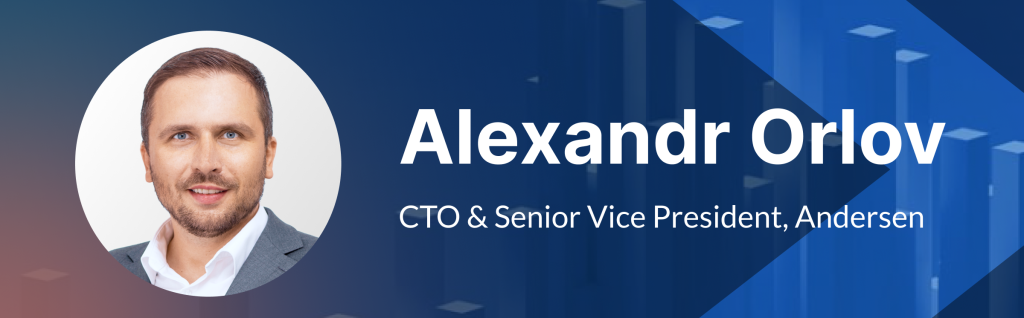
Alexandr Orlov has spent nearly two decades keeping order at Andersen. As CTO, he builds processes so the team works predictably and well, without relying on individual heroics. As it turns out, bureaucracy doesn’t just save a business — it can drive it forward.
2Digital: Andersen has 16 offices and thousands of developers worldwide. How do you manage to keep the company’s actions aligned without turning management into a bureaucratic hell?
Alexandr: There’s a saying: “Bureaucracy defeats corruption.” I really dislike bureaucracy, but as it turns out, people who dislike something but still want to do it are the best at doing the thing they dislike. So I’m exactly the person who introduces plans, tickets, schedules, rules, and demands that they be followed. Of course, it’s not only me; a team helps me.
If discussions and decisions aren’t documented, a lot gets lost. To avoid chaos, you need to capture every idea, task, and workstream in writing.
This is what raising the company’s maturity level looks like. The business becomes stable and controllable, able to adapt and deliver repeatable results without relying on a handful of people’s heroics or on ad‑hoc workarounds. Essentially, it’s all about more digitized processes. And the more we digitize them, the more data we get; we make decisions not by intuition, so that we can control the situation and influence it.
So I’m in favor of bureaucracy. People sometimes say it should be moderate, but I think that’s some kind of populism; it should be effective.
2Digital: This is another global problem — preserving effectiveness as scale increases.
Alexandr: For work to be effective, the people working for you must understand that the tasks they are dealing with are needed. When a company grows, a leader is physically no longer able to check every decision. People start making more decisions themselves, and if they do not understand what business problem they are solving, they start doing what is pretty instead of what is useful, or they optimize locally while worsening the overall result; they do not see meaning in the work and, in the end, lose motivation.
Understanding the purpose helps people make the right calls in unusual situations, so everyone pulls in the same direction instead of working at cross‑purposes. We don’t do busywork; everything we do contributes to the company’s growth.
Also, as I said earlier, it’s important to document tasks. In a small team you can just say, ‘Do this,’ and everyone gets it. In a larger organization, that turns into endless follow-ups, people retelling things to each other, and agreements getting lost.
When a task is written down — whether in a tracker, an email, or a doc — there’s a single source of truth everyone can refer to. It makes the scope, deadlines, ownership, and expected outcome clear.
In other words, documenting tasks removes gray areas, prevents duplicate work, and stops people from going in circles.
These topics have been studied for years, and there’s plenty of good literature on them. The key is to learn from it and apply it thoughtfully, with your company’s reality in mind. You can’t, for example, copy recommendations written for a U.S. company and apply them word-for-word to a company in the CIS.

2Digital: Responsibility for making decisions about cooperation also rests with you. How do you determine whether you will work with a particular person or company? How do you assess the prospects?
Alexandr: There are, of course, some quasi-scientific methods. For example, you can run due diligence on a prospective contact: study the facts about them, verify documents, look for traces in public sources, and check reputational markers. But visible business reputation is not always a complete or fully accurate picture. In the end, you can only tell whether you’re dealing with a person of their word or a person of action after direct and sometimes lengthy real-world interaction. It’s like marriage: before the wedding a person seems one way, but once you start living together, they turn out to be entirely different.
When it comes to potential partners, they really may embellish their capabilities at first, but in the course of working together the reality becomes clear very quickly.
That is what genuine partnership is — finding a way to align intentions with capabilities, stepping up where needed, making concessions where required. If that kind of symbiosis exists, then you can speak of a long and fruitful relationship.
2Digital: Your decisions determine how reliable the systems used by thousands of people will be. As the CTO of a large company, how can you tell at the early stages of development that the solution you’re building will be high quality?
Alexandr: As I said earlier, I consider bureaucracy an important component. I constantly pester my employees to improve the principles by which they evaluate their work from different angles. I’m not exactly popular for that, of course. But I’m convinced that the better we ourselves understand the evaluation criteria, and the more boldly we identify the pitfalls, assumptions, and constraints, the stronger our team becomes—and that means fewer problems down the road.
Sometimes it becomes clear that proper requirements gathering is impossible. Then assumptions come into play, and the more precisely we understand what we will do in a given situation, the better our quality will be.
It may sound like something easy. But in reality, I’ve been refining these processes for at least the last fifteen years.
2Digital: Which decisions would you keep at the level of top management, standardizing them and tightening the screws, and which would you delegate to the project team to decide internally, among themselves?
Alexandr: I believe that everyone should march in step. The effectiveness of this approach is confirmed by global practice as well: a tightly regulated company may be less agile, but it moves forward better, more confidently, more consistently, more reliably. Many people like the startup mode, but in the long run, order always wins. So anything that can be standardized is better standardized.
2Digital: A leader has to make decisions that affect the entire company under conditions of incomplete information. Do you have any principles for decision-making in such cases? What do you do if a managerial choice turns out to be unsuccessful?
Alexandr: In fact, all of us are constantly operating with incomplete information. At the same time, we’re flooded with junk data. I turned off social media and realized my awareness didn’t get any worse. But I gained more time to take in useful information.
So I would say one effective method is to first remove the excess informational noise that prevents you from analyzing what really matters.

2Digital: Why do strong technical solutions, in your view, so often fail to reach marketing realization? For instance: the solution is great, but it produces no commercial result; in medicine, 90% of startups don’t even make it to a market launch.
Alexandr: In medicine, this can happen for specific reasons: there’s Big Pharma, and it’s not easy to compete with it. But in my field, if a solution is technically good, it will most likely take off. That’s why I went into IT: with a high-quality product in hand, you can compete boldly with giants.
For example, Uber appeared — a revolutionary app — and became popular in many countries around the world. Then we saw Bolt, and it turned out to be successful as well. And now other analogues are emerging in Latin America and Central Asia, and they find their audience, sometimes even overtaking Uber and Bolt in their regions. In fact, we work with one of these apps.
I’m convinced that if a company is fired up and ambitious, and understands what needs to be done and how, it always has a good chance of breaking into the lead.
2Digital: Is there any framework for evaluating project ideas that people bring you?
Alexandr: Our task is to implement as precisely as possible what the customer asks for. For example, if you’re told to build a bakery by the sea, your job is to make it high-quality, convenient, and attractive.
We don’t diagnose ideas; we assess how and with what resources the task can be accomplished, and we also factor in risks, of course. When we do a high-level estimate, we allow for an error margin of 5–10%. When we do a part-by-part estimate, the difference can already be 20–30%: once you start digging deeper, you uncover more uncertainties, dependencies, and risks, and you can name a more realistic range.

2Digital: You also act as CEO in the BrightBirds project and in employee training. At what level, and with which methods, do you think training is most effective today?
Alexandr: We have engineering practices, and internal and external services that we provide. My people’s job is to train specialists inside the company: how to deliver these services to the client, and how to work with them after the sale has been made.
As for methods, I want to note that in today’s world a significant part of knowledge becomes obsolete instantly. That’s why hands-on workshops work. For example, we’re going to provide a mobile development service, and our task is to answer an employee’s questions in a practice-oriented way: what does a mobile development service consist of? How do you sell it? How do you support it? And so on. If a salesperson or delivery manager wants to learn all this, it will be much easier for them afterward to deliver the product or service to the client.