


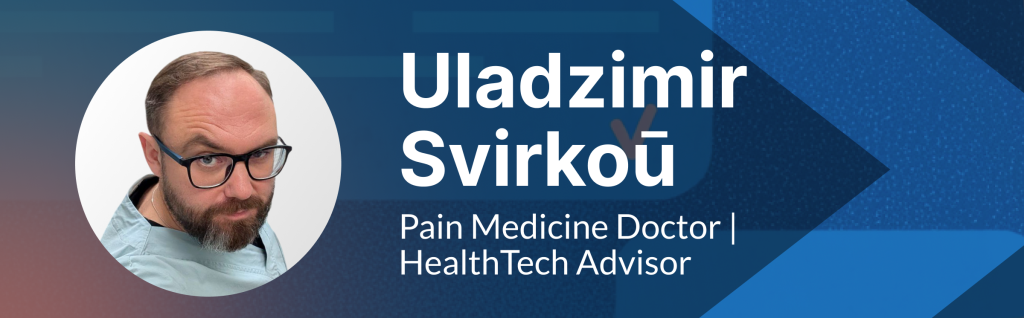
In late 2025, the market is saturated with medical apps and digital therapeutics, yet new HealthTech ventures keep launching. Is there a room or need for more? Dr. Uladzimir Svirkoū, a Pain Medicine Doctor and HealthTech Advisor, argues that as long as problems like endless MRI waiting lists persist, technical solutions are required.
In this interview, Dr. Svirkoū dives into the conservative nature of clinicians, the essential role of insurers, and the importance of solving non-obvious problems instead of just chasing quick money.
2Digital: As of late 2025, the market for medical apps, devices and digital therapeutics is saturated. Nevertheless, companies are still choosing to launch new HealthTech projects. In your view, does the market today actually need these kinds of projects?
Uladzimir: Yes, it does, because the number of problems in healthcare is not getting smaller – take at least the endless MRI waiting lists in prosperous countries, such as Austria. As long as there is dissatisfaction with how healthcare works, there should be technical solutions that help address these problems.
If at some point it turns out that everything is finally great, healthcare works exactly the way we want and it is impossible to make it better – then there will be no need for new projects.
What there is not, are easy fixes and quick money. Before entering this market, a team has to account for many factors that are often specific to the sector.
The first question I would ask is: why do you want to do this?
The next – is who exactly the product is for. It is a completely different story if a solution is built for a supranational organization, such as WHO, the UN, or for a ministry of health, or for a clinical holding company that owns multiple hospitals. Or the user might be a private clinic, a public hospital, an individual physician, a patient, an insurer. Whose problem is being solved?
That can be a very broad set of stakeholders – all those who are willing to pay to have their specific problems addressed.
2Digital: Does that mean stakeholders must always be involved in product development? And if so, to what extent?
Uladzimir: Here it depends on who the original client is. There is not always a strict need to have a physician on the team. If the product is being built for a ministry of health, for example, a doctor in the core team may not be essential. The same can be true for pharma. What is essential is to have direct contact with someone from that environment – with the person or group that will eventually use the product.
2Digital: And if the end users are patients? For example, people with a chronic obstructive pulmonary disease. Should patients be brought into the team?
Uladzimir: That is a good question. If a patient is included, it is easy to end up narrowing everything down to that person’s own idea of what the problem is.
There is a subset of patients for whom technology is not alien – let us call them technophiles. They can navigate digital tools, can understand what is on offer, are prepared to try new things and invest effort. This is not the average user, it is more of a special case. A product can definitely be built for this segment. I am not sure, however, that the information from this segment will be valid for the entire market.
On the other hand, people with chronic obstructive pulmonary disease are often older, long-time smokers. and their problems are frequently voiced not by them but by relatives. It is often the relatives, grandchildren who want to solve the problem – but their answers are not the same answers the grandmothers and grandfathers would give themselves. These are our assumptions about representatives of the target group.
So I am not sure whether patients should be part of the development team, and if so, which ones. What is clear is that user feedback is needed.
2Digital: What barriers for adoption do you see on a level of practical medicine?
Uladzimir: In the environment where I live and with the patients I see, it is noticeable that people in general do not use medical apps very often and do not search for them much. And among those who do, most stop using new gizmo after a month. Effectiveness of adoption is increasing when a doctor comes and says: look, here is this app or this device; if you take it and use it, in return you will get better insurance terms.
Recently, patient access to their X-ray images was introduced (in Austria, ed. note). A service at this scale did not exist before. At first everyone was unhappy, but when the service finally started working nationwide, it finally became accepted by patients and healthcare professionals: now a person comes to me, shows a PIN code, and I quickly get access to the needed information.
However, this adoption did not happen because doctors and patients spontaneously decided to use the system. It required organizational effort from the state and insurers. It often has to be recognised that even if a startup genuinely addresses patient problems, reaching the target group will not happen directly, but via those who can activate administrative levers.
If we are speaking about some fitness gadgets that make life easier and more pleasant, then, perhaps, marketing alone is enough. But if we are speaking about a medical app or a tool, it has to be promoted like a drug. If the aim is for tools to be used in clinical practice, entry has to be through clinics, physicians and insurers.
Let’s say I have an app that records my ECG. But if I know that when I go to the doctor, they will look at it and say: “Well, great, I don’t know this app, what am I supposed to do with this information?”. With such feedback from a physician, the share of people who actually use this app will not increase.
The next barrier worth mentioning is that doctors do not want to spend time on a thorough review of extensive medical documentation, and often objectively do not even have that time. I think one of the biggest “sins” and secrets of clinical practice is that long patient records are skimmed over — a person simply cannot go through such a large stack of papers during a single consultation.
Furthermore, in my view, clinicians are conservative. Any new device or tool that requires a change in the standard behavioral script will initially be perceived as an increase in workload, not a reduction.
So if something is to be introduced into the medical environment, it is better to do it in a way that is almost invisible – by integrating it into existing workflows.
A very simple example. All our lives we have written reports by typing them. Then dictaphones appeared, and we started dictating. A whole large staff of secretaries began to transcribe these dictations. This is very convenient for foreign doctors whose grammar is not perfect: they dictate however it comes out, and the secretary turns it into a clean text.
And then, at some point, while dictating, I noticed that a line was appearing on my computer screen that was automatically converting my dictation into text. I thought: okay, this is nice. Then the system started correcting mistakes.
This was implemented in a way that did not break existing routines or patterns. Step by step, I seamlessly switched from typing to this speech-to-text device, which does not require anything different from what I was already doing – it just makes it easier and does not require retraining.
It transforms my practice, gradually and gently pulls me in, and at some point I suddenly realise that I am using it everywhere. This is how implementation will work among physicians.
2Digital: Yes, but that is not always possible.
Uladzimir: Sometimes a new tool has to be introduced – for example, a new endoscopy system – and it simply cannot be made identical to the old one. There will be different buttons, a different manual, and retraining will be needed in any case.
The benefit is obvious: you look at the screen and see immediately that the difference is akin to the difference between an analog and a digital TV. But time still has to be spent getting used to the new buttons. Even this creates resistance that is very hard to overcome.
This is something a startup entering the market has to factor in. The rose-tinted glasses have to come off, and there should be no expectation that once a “great thing” is brought into a hospital, all the doctors will say: “Wow, this is exactly what we have been waiting for all our lives.” It is unlikely to play out this way.
In my own practice, there was an attempt to implement an electronic system for preoperative assessment.
The idea was excellent: no need to fill everything in by hand, or leaf through medical records and papers. Everything opens in electronic form, all the information about the patient is visible, everything is printed, risks are calculated, and a printout can be generated.
For years before that, everyone had complained about the piles of paperwork, illegible handwriting, and so on, and had called for an electronic system. The system was developed, implemented, presented to the medical staff – and the resistance was enormous.
Even clear evidence that the amount of work had decreased did not convince many. The process was different, and it radically changed the behavioral pattern. In the end, implementation had to be gradual.
Changing the script is very risky.
I have seen the same thing with anaesthesia machines. A new machine is brought in, and I look at it and see a spaceship compared to the simple device I had before. I understand that it can do much more, but I cannot be bothered to press all those buttons and learn it. That is how it is in the first week, the second, the third. But there is no other machine, so I have to get used to it, and suddenly I no longer understand how I ever worked without it.
2Digital: For founders and startups it is crucial to find people in practical medicine who will act as champions – believe in the product and start promoting it. Where are these people?
Uladzimir: Let me start with the difficulties: doctors and healthcare managers generally do not like working with startups.
A startup comes to a hospital with a great product and says: “We will sell it for 3,000 euros a year.” The hospital says: great, sounds good. The next thing the head of the technical department will do is check whether Philips, Siemens, Thermo Fisher or someone similar offers the same or a comparable solution.
And even if they find something roughly similar, perhaps worse than what the startup offers, and instead of 3,000 it costs 15,000 – the hospital is still more likely to buy from Philips. Because Philips is here today, will be here tomorrow and the day after, and with a startup this is not guaranteed.
So selling the startup to a major stakeholder is, in reality, a way to get into a hospital.
Insurers are another potential entry point for smaller companies. In my experience they are slightly more open, especially private ones.
There is also a route via clinical research. This comes with fewer obligations for hospital management or department heads when they want to introduce a new product.
We come and say: “Look, we have this great device.” The hospital director immediately tenses up: “So you want us to buy it?”
And then the answer can be: “We can start with a study.” Research is something everyone likes, especially university hospitals. They even need it because they are paid for it.
They run the study, learn how to work with the device, and if effectiveness is demonstrated, then a return visit to the hospital director would be much more promising. The director might even want to buy a stake in the company – and then the product becomes embedded in the hospital or even in the entire hospital group, depending on how things turn out.
2Digital: So how to engage people?
Uladzimir: You need to meet in person, ideally in small groups. Remote formats do not work very well here. People need to be heard, and there has to be space for conversations about real life. People like to complain, doctors especially. Hospital directors like to complain, patients too.
This person knows exactly where it hurts, and someone with a technical background may have a broader view of which tools could help relieve that pain. More than once I have seen the following situation: you say, look, here is this problem – and suddenly an engineer says, “Why not just do it like this?” And you catch yourself thinking: right, why not? It is completely obvious and was just sitting there on the surface, yet it never occurred to you.
The ways teams are put together have hardly changed for decades – it still comes down to getting people in a room and talking.
2Digital: On top of that, statistics say that around 90% of startups never make it to clinical use – and yet people keep building products. Who are these brave people?
Uladzimir: I think there are two main groups. The first, in my view, are people for whom something genuinely “hurts.” They have some personal connection with healthcare.
The second group are people who want to make money – in the good sense. Wherever one looks, healthcare stands out: forecasts say the market is large and will keep growing, into the hundreds of billions and beyond. There is also a widespread perception that doctors earn a lot, that this is a wealthy environment. Pharma is associated with big money too – the “new oil.”
And everyone knows that illnesses will continue to exist. People are prepared to invest in their health because it is extremely valuable and it makes sense to do so. This, in my view, is why people are willing to keep launching projects in healthcare, investing and hoping that something will take off.
Why does it so often not work? In my opinion, the reason is that we choose to work on problems that are not “real”. The real problems in healthcare – for doctors or for patients – are often not so obvious. Many of them are not as romantic as “let’s beat cancer.”
Take MRI waiting times. Where I live, an MRI can be done privately in a week for 300 euros, or for free if one is prepared to wait four weeks.
Getting an appointment with an ophthalmologist takes six months. With a rheumatologist – even longer.
This problem seems to be present across Europe, and it looks so complex that almost no one is trying to tackle it seriously.