



Debates about the advantages of drone technology tend to descend into a zoo of technical specifications such as range, sensors, autonomy, etc. But the talk often quickly turns to comparisons of different platforms and spirited arguments over which system looks better on paper. Yet recent momentous decisions regarding defense policy, alongside the realities of modern battlefields, indicate more profound change. Platforms are still important, but by itself they would not guarantee a competitive edge without smooth integration across existing forces, ensuring agility, fast updates and scalability.
It is absolutely not enough to get the latest autonomous systems as a rare, high-tech asset — the basic logic dictating its use is also on a major transformation. In the Q2 of 2026 the advantage will be gained by whoever can keep autonomous capabilities up and running under pressure.
From Platform to Scale
The scale of this shift comes through clearly in official statements. In a Department of War release on the rapid production of more than 300,000 drones, Pete Hegseth stated that the armed forces would receive tens of thousands of small drones in 2026, and hundreds of thousands by 2027. The emphasis is not on any single standout platform, but on pace and volume. We are watching a fundamental rethink of how military capability is built.
When a system has to operate with tens and hundreds of thousands of units, it is not enough just to possess hardware somewhere in the labs, it becomes a management skill issue – who has the more stable supply chain, maintenance, operator training, etc.
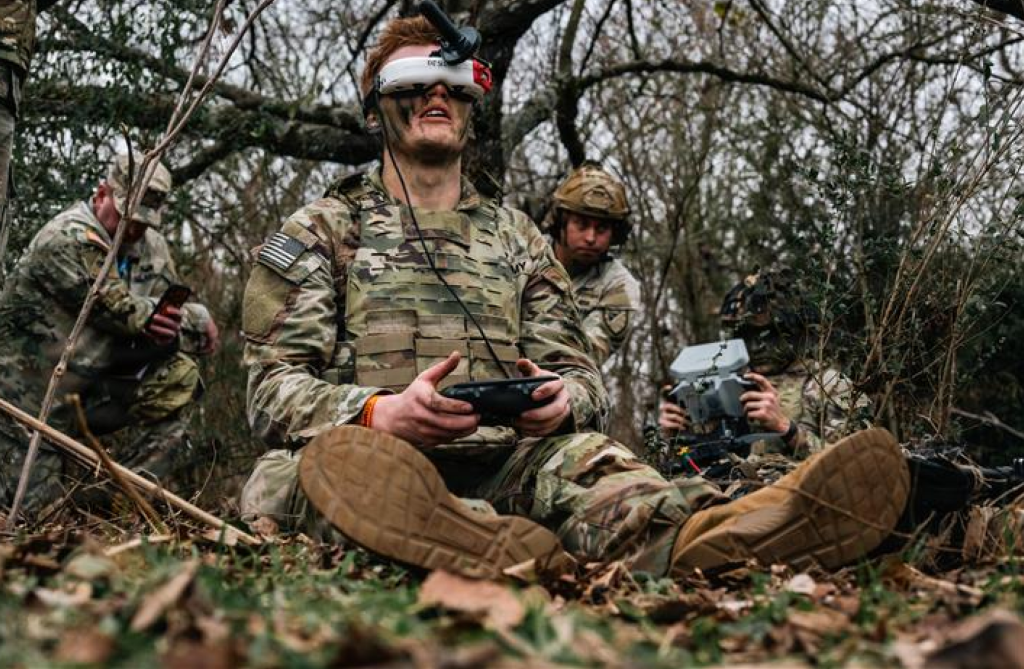
In the photo below, on February 18, 2026, at the U.S. Army Best Drone Warfighter Competition in Huntsville, Alabama, soldiers piloted a drone during the Best Tactical Squad Lane event. Competitors came from the active-duty Army, the Reserve, and the National Guard. Formally, it was a contest to find the best drone operator. In practice, it was a showcase of a new military baseline: adaptability, speed, and proficiency with unmanned systems are becoming standard requirements — not exotic skills. It was the first competition of its kind, and its theme was blunt: Agile, Adaptive, Lethal.
Recent real-world combat conditions have only reinforced this logic. This no longer fits neatly into the old logic of defense procurement. Historically, military advantage was closely tied to platform survivability and technological superiority. Now planners are increasingly prioritizing manufacturing capacity, modularity, and sustainment chains. The question is no longer which system stands out on its own. What matters is which structure can better rebuild capability under heavy load.
Production Speed as a Strategic Factor
Defense company executives are now saying this out loud. Anduril CEO Brian Schimpf has publicly stated that technical superiority isn’t enough — a system has to be producible quickly and at scale. That’s a significant reframing of what superiority even means. If a superior platform can’t be turned out in the right numbers fast enough, or if its cost is disproportionately high, its operational value becomes severely limited.
In this model, production speed becomes a component of deterrence. What counts is not just the inventory of systems already on hand, but the ability to rapidly top it up, spread it across the theater of operations, and adapt it to a changing environment. That’s why new manufacturers are betting on digital engineering, modular design, and short feedback loops. The goal is no longer to ship a perfect platform at first release. Far more important is keeping a system in a state of constant readiness — able to respond quickly to new battlefield conditions and adapt to them on the fly.
This also reshapes the role of the industrial base. It’s no longer just a backdrop to war. Production lines, component suppliers, software updates, access to low-cost strike and countermeasure tools — all of these are becoming part of combat readiness. The faster production cycles shrink, the wider strategic flexibility becomes. The greater the capacity for rapid replenishment, the stronger the deterrent effect: an adversary has to factor in not just current losses, but the speed at which those losses will be made good.
Integration Beats Isolated Performance
Even massive scale on its own doesn’t deliver an advantage if systems are operating in silos. Autonomy only becomes genuinely meaningful when drones, sensors, communication channels, and command structures work together as a single network. That’s exactly why co-founder and president Brandon Tseng puts it this way:
“At Shield AI, we believe the greatest victory requires no war. To make that belief real, we’re executing a simple but ambitious master plan: prove the value of autonomy, scale it across domains, and reimagine airpower.”
The phrase about scaling across domains is the key one here. Autonomy can’t be locked into a single platform or a single mission. It has to work in the air, on the ground, and at sea — tied together by shared data and unified command structures.
That requirement shifts the focus away from flight performance alone and onto system architecture. You need compatible standards, common data formats, clear rules for software updates, and a well-defined division of authority between operator and machine. In today’s environment, operators are less and less likely to be manually flying a single aircraft — they’re increasingly overseeing several systems at once. Commanders aren’t working with one platform; they’re working with a stream of information from a distributed network. If that network isn’t pulled together into a coherent loop, scale stops being an asset and starts generating friction: duplication, information gaps, and fragmented decision-making.
From a technical standpoint, the core challenge has long since moved past making a single platform carry out a task without direct human input. The harder problem is getting thousands of autonomous systems to operate in sync within a single strategic architecture. That’s where the quality of an operational model is really put to the test. It either turns scale into real capability — or produces a lot of noise, overloaded channels, and decisions that don’t add up.
Replaceability and Operational Resilience
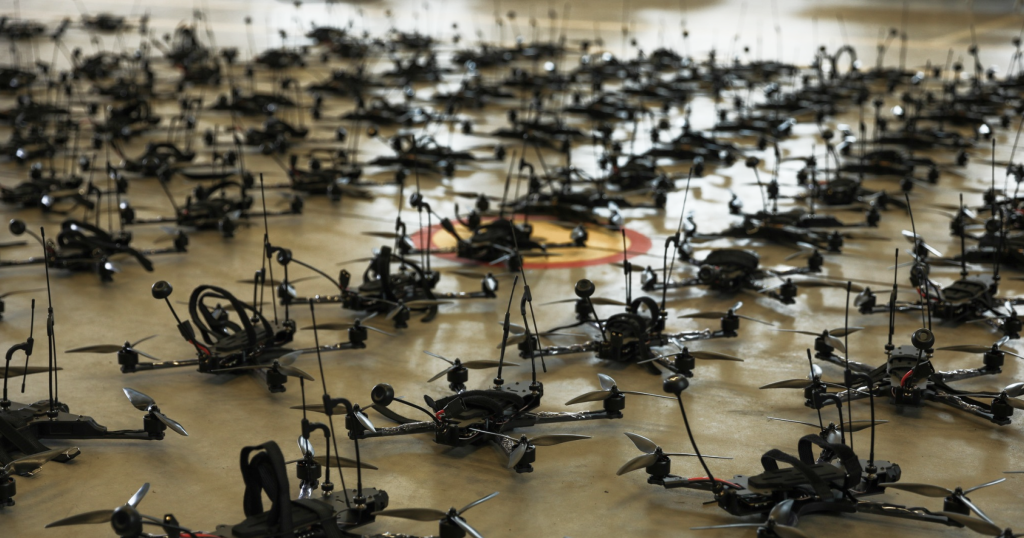
Another significant shift in how drones are being designed and built is the changing attitude toward losses. Autonomous systems are increasingly less likely to be treated as an exclusive resource whose loss is nearly unacceptable. Instead, they are more and more being designed as a mass-use tool that has to hold up under a high operational tempo and be swapped out quickly. Under this logic, effectiveness is measured not just by how long a single unit lasts, but by the overall throughput of the system: how quickly the right equipment reaches troops, gets used, goes out of service, and comes back in an updated form.
Losses are increasingly treated as part of operational planning — becoming a factor that must be managed through rapid replacement and sustained capability. This means replacement timelines, supply chain elasticity, and production flexibility are no longer administrative metrics. They’re operational ones.
In effect, systems are now being deployed, assessed, adjusted, and sent back out again in cycles that look far more like software development than traditional aerospace programs.
This also feeds into how people are trained. An operator can no longer get by just knowing one platform inside out. What’s needed are skills in system monitoring, anomaly detection, rapid task reallocation, and working through partial network degradation. The human role is evolving — becoming more supervisory, analytical, and organizational. The wider the scale of autonomy, the more valuable it becomes — not just to have the right hardware, but to have an organization that can train people to operate effectively inside a distributed ecosystem.
What the Current Operation Against Iran Has Revealed
These conclusions are already being tested — not in theory. Since late February, the US and Israel have been running a large-scale campaign against Iran, with drones deployed in mass numbers on both sides. According to Reuters, the war kicked off on February 28, 2026. The US and Israel are striking military and industrial targets, while Iran is hitting back with waves of missiles and drones aimed at Israel, American installations, and infrastructure across Gulf states. By mid-March, the conflict had entered its third week. Reuters also reported Iranian drones operating in the airspace of Kuwait, Iraq, the UAE, Bahrain, and Oman, while AP noted that one strike on a US facility in Kuwait killed six American service members.
The operation quickly brought several challenges into focus that had until recently been debated mostly in expert circles — and that are now playing out in an active conflict.
The first is the cost ratio between interception and attack. AP notes that the US and allied forces have employed hundreds—if not thousands—of Patriot missiles in defense against Iranian rockets and drones , even though the attack drones themselves cost orders of magnitude less. As a result, forces have had to rapidly broaden their countermeasure toolkit — leaning more heavily on helicopters, heavy machine guns, and drone-on-drone systems, rather than depending solely on expensive surface-to-air missiles.
The second is saturation and defense overload. According to AP, Iran launched more than 2,000 drones in the opening days of the war, and while the majority were shot down, some still got through. Drone warfare expert Brett Velicovich put it bluntly in comments to AP: “if just one drone gets through and wounds an American, the problem needs to be fixed.” That’s a key point. In mass drone warfare, the question is no longer just about the average interception rate — it’s about what each individual breach costs.
The third is control of low-altitude airspace. Northwestern University professor William Reno, quoted by AP, said: “The long-run effect will probably be that it’s going to focus minds wonderfully on thinking more seriously about cheap stuff that comes through the air.” He also pointed out that the previous American strategy was focused primarily on controlling the altitudes where fighters and bombers operate. Mass-use drones are forcing a rethink toward an entirely different layer of warfare — low-altitude, saturated, cheap, and extremely dense in terms of target count.
The fourth problem is the vulnerability not just of military targets, but of civilian and logistics infrastructure. Reuters reports Iranian drone strikes on facilities in the UAE, including the area around Dubai Airport and the port of Fujairah. This means drone warfare is quickly spilling beyond the traditional battlefield and starting to hit transportation hubs, energy infrastructure, insurance markets, maritime logistics, and the political decisions of allied governments. Reuters also reports that traffic through the Strait of Hormuz has dropped by 97% since the war began. Here, the drone is no longer just a strike weapon — it’s a tool of economic pressure.
The Implications Go Well Beyond Defense
This shift matters well beyond the military sphere. Civilian organizations trying to scale artificial intelligence are running into a very similar challenge. Having a powerful model doesn’t guarantee success on its own. What’s decisive is the operational environment: how the system is updated, who is accountable for its behavior, how constraints are built in, and how reliability and controllability are maintained.
That’s why the question of drone dominance today is less about any single platform and more about broader organizational capability. Production, integration, sustaining scale, training people, and built-in oversight mechanisms are gradually becoming more important than one-off technological breakthroughs. It is precisely this ability to maintain autonomy as a permanent, ongoing state — rather than a peak achievement — that will determine the edge in the conflicts ahead.