


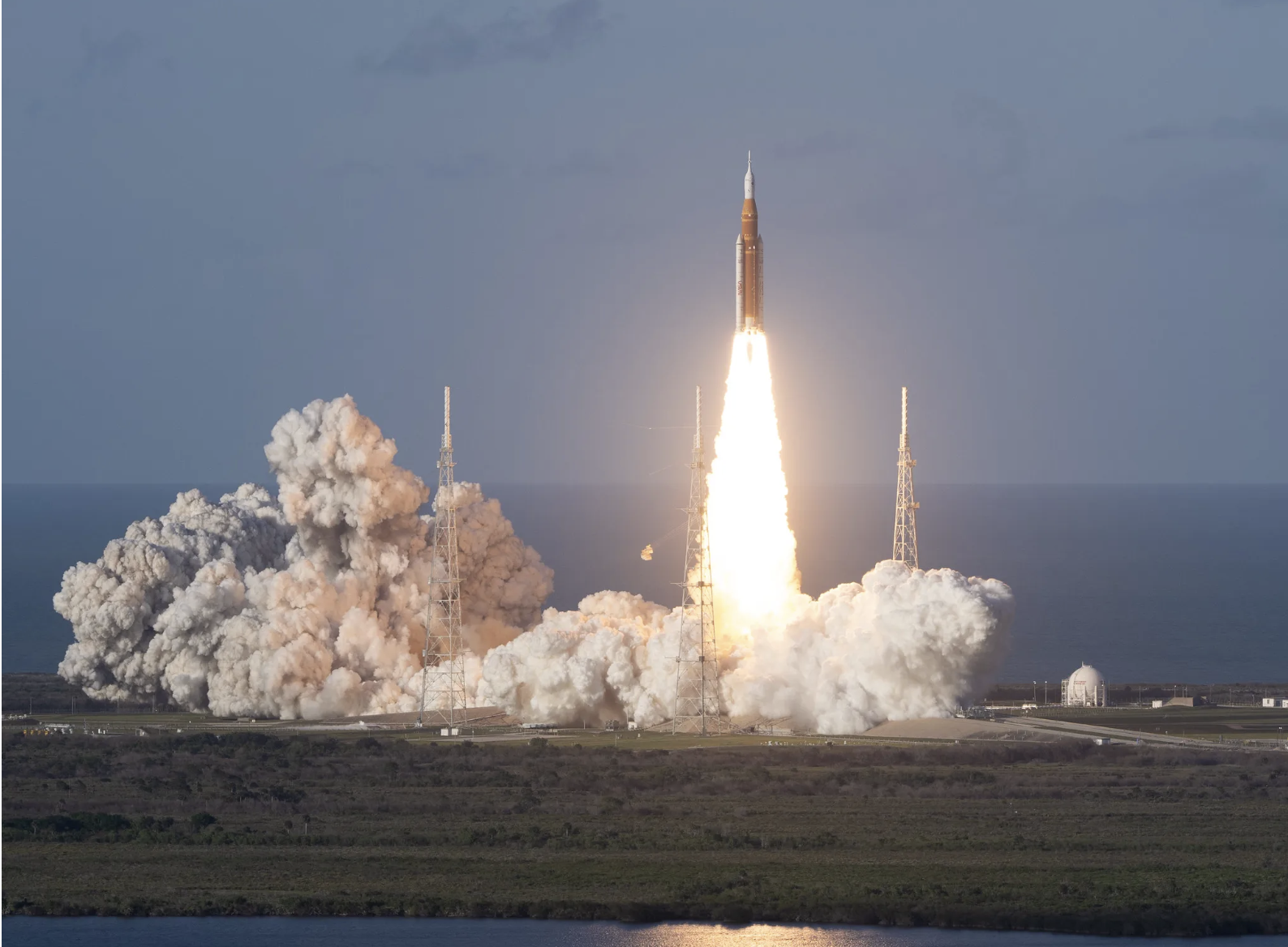
The American lunar mission Artemis II launched on April 1 from Kennedy Space Center. It marks the first crewed flight to the Moon since Apollo (1972) and the first crewed mission of the Artemis program. The SLS rocket carried the Orion spacecraft with four astronauts on a 10-day lunar flyby mission before returning to Earth.
One important clarification upfront: Artemis II is not landing on the Moon. This is a crewed flyby — a flight test of all key systems with a crew aboard. If everything goes smoothly, the program will advance to its next steps.
A demonstration mission in low Earth orbit is planned for 2027, where NASA intends to test Orion’s docking with commercial lunar landers and rehearse key operations ahead of a landing. The first crewed lunar landing — Artemis IV — is scheduled for 2028.
Running in parallel is another critical milestone: the construction of Gateway, a small station in lunar orbit. NASA describes it as the central element of the Artemis architecture — a staging post for lunar expeditions, a scientific platform, and a foundation for a longer-term human presence near the Moon. For Artemis IV, NASA has previously outlined exactly this scenario: a flight to Gateway, dockings in lunar orbit, and from there, support for surface operations.
NASA reported, that the mission is proceeding as planned: Orion’s solar arrays deployed successfully, orbit-raising maneuvers were completed, and the crew conducted a proximity operations demonstration — a manual maneuvering test of Orion relative to the upper stage.
In other news from aboard: the crew and mission control successfully resolved an issue with the onboard toilet.
The Artemis II flight is scheduled for approximately 10 days. On Day 2, Orion is set to perform a translunar injection burn and head toward the Moon on a free-return trajectory. On Day 5, the spacecraft will enter the Moon’s sphere of influence, and on Day 6 — around April 6 — it will pass behind the far side of the Moon at a distance of roughly 4,000–6,000 miles from the surface. At that point, the crew will be at their farthest from Earth, capturing photos and video of the Moon, while communication with the ground will go dark for 30–50 minutes — a standard part of the flyby. Orion will then turn for home, with Days 7–9 reserved for trajectory corrections and system checks ahead of reentry.
Splashdown is planned for Day 10 of the mission — around April 10, 2026, barring any schedule changes. Before reentry, Orion will perform a final trajectory correction, after which the crew will reconfigure the cabin to landing mode and suit up again. Following separation of the service module, the capsule will enter Earth’s atmosphere, where its heat shield must withstand temperatures of around 3,000°F (approximately 1,649°C). A series of parachutes will then deploy, slowing the capsule to roughly 17 mph before it splashes down in the Pacific Ocean, where NASA and U.S. Navy recovery teams will be waiting.