



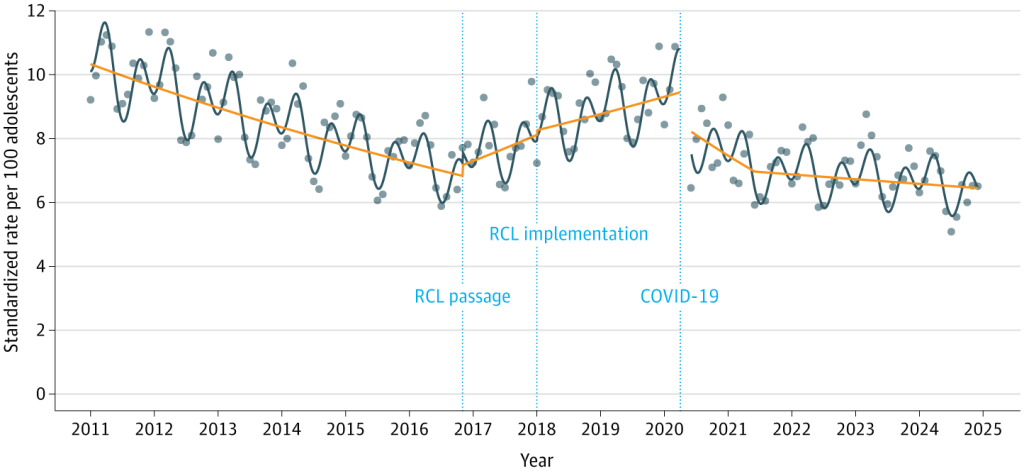
For years, California has served as a testing ground for marijuana legalization. The study published in JAMA Network Open shows that initial fears of a sharp spike in youth consumption were entirely justified. From 2011, the teen smoking trend had been steadily declining, hitting a low of around 7% in 2016 – the exact year recreational cannabis laws (RCL) were passed. Immediately after, the consumption curve skyrocketed.
Cannabis popularity peaked at the turn of 2019 and 2020. The average usage rate surpassed 9.5%, and during the peak months, 11 out of 100 California teens admitted to using marijuana. However, it wasn’t state regulations but the outbreak of the COVID-19 pandemic that halted this growth. Lockdowns, school closures, and direct parental supervision triggered an immediate collapse in the statistics. The latest data proves that consumption has stabilized at roughly 6.5% – a figure lower not only than pre-pandemic records but even below the milestone year of 2016.
Despite this statistical reset, healthcare professionals are sounding the alarm. A key element of the study was the simultaneous analysis of the health trajectories of a massive cohort of 463,396 teenagers. The gathered medical data indicates that teens who use marijuana are over twice as likely to be diagnosed with psychosis or bipolar disorder later in life. Additionally, they showed a 34% higher risk of developing severe depression and a 24% greater likelihood of experiencing chronic anxiety.
The psychological threat is constantly amplified by a drastic shift in the social perception of the substance, especially among young people. Dr. Lynn Silver of the Public Health Institute bluntly summarized this phenomenon in an interview: “With legalization, we’ve had a tremendous wave of this perception of cannabis as a safe, natural product to treat your stress with. That is simply not true.”
Doctors view the current post-COVID statistical drop to 6.5% as a critical window of opportunity. It represents a brief period for immediate intervention and mass education before marketing and other factors inevitably drive the numbers back up.