


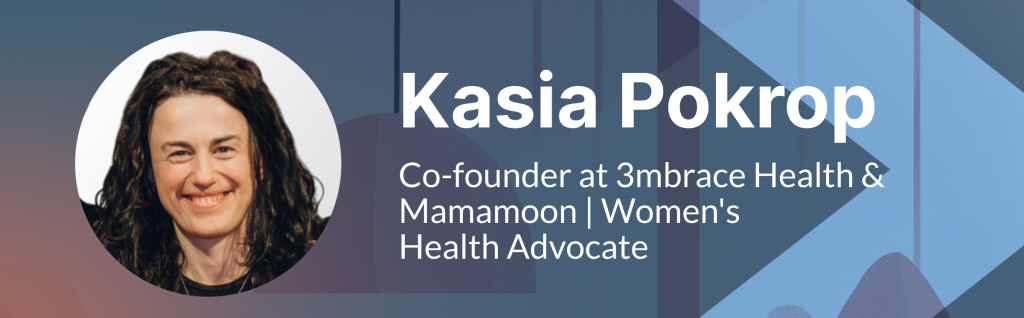
How do you redesign the workplace so that women can thrive through every stage of life? We talked about that with Kasia Pokrop, co-founder of 3mbrace Health and Mamamoon, and a women’s health advocate who is helping companies create healthier, more supportive environments through digital tools, expert talks, workshops, and HR training — all centered on the “three M’s”: menstruation, motherhood, and menopause.
2Digital: When I talk to people who are taking on so many responsibilities — being a parent, a CEO, an advocate — I wonder. Why do you need all that? Why not choose something easier?
Kasia: I could have found something easier, definitely. I’ve spent a long time in the corporate career with a stable salary, nice challenges, nice colleagues on the team. It was a process of getting there. But it was also a process of conditioning my own experience. Eventually, we started 3mbrace Health with Mamamoon, which initially was all about pregnancy, birth, and postpartum. And it was me coming from Eastern Europe, seeing basically the gap between Poland and the Netherlands in care, and gradually understanding that I am able to bridge it.
So it was like this fire in you that you see the pain, and it’s not just your pain, it’s a pain and fear shared by lots of women. And then you’re like: “oh, I know how to fix it”.
So it was a process — going in that direction.
How do I manage? I think a part of it is that you know why you’re doing it — the pain is still there. There are still lots of women, scared of giving birth or becoming a parent, dealing with postpartum depression. And now with 3mbrace Health, we address all the “3 Ms”.
Initially, we thought about motherhood, and it is definitely a big thing. And then we saw, there is more that requires support, whether it’s the menstrual cycle or the menopause, or so on. So it’s another part of how I manage — is just seeing the gap. And I am constantly motivated by bridging it, by seeing how it impacts women’s lives.
The biggest motivator of all is my daughter, though. I don’t want her to have to figure it out as we do right now; things should be smoother. So yeah, it does give you the energy that we need a lot when building.
2Digital: Do I get it correctly that your main target clients are B2B now?
Kasia: We are landing contracts with companies, but eventually we serve the employees. So it’s rather B2B2C — organizations bringing us on board to do the training, the workshops, to equip the female employees with the mamamoon app when they are pregnant.
The first reason for that is the structure we have — participants of our workshops are the same women — whether as individual clients or as a corporate. The second reason is that we need to be smart about where to apply resources we have, how to make a bigger impact. If you have an organization that is hiring us to help the employees, then we have one client, but essentially we are helping hundreds of those employees. We also train managers, many of whom are men to support the entire team. This creates a ripple effect where our impact extends beyond the initial female employees we directly reach.
2Digital: From the employer’s perspective — why would they care? They pay a salary, obey legislation, maybe that’s not their problem?
Kasia: Well, if you go to an employer and say: “I would like your employees to be happier”.
Indeed, many of them wouldn’t care. But if you go to a company and start asking: “Hey, how many sick leaves do your employers have? How many burnouts have you had? What is your retention rate?
And then it’s like “Oh, wait a second”.
We actually have a lot of sick leaves in this age group. This is annoying because we are investing to have more female employees in the leadership, but after they become moms they’d never come back.
Twisting the way we pitch, we are able to get in easier, and then you start talking about saving costs.
Also there are national policies on women’s health — in the UK, for example, starting from 2027 big companies with over 250 employees, will have to introduce a menopause policy in place. And that’s great, right? Because that means flexibility and more understanding. And it also means not losing those women who just got through the first glass ceiling in their career, and then immediately hit another one, having hot flashes, brain fog, anxiety, which is very common in menopause. So companies don’t want to lose it, and it’s again, about saving the costs, and having women working longer.
A bit easier for us to talk with companies that don’t have that many women employees, but they want to have more. Some tech projects for example. There’s only 20% female students among those who leave tech studies.
Let’s simplify here — you’re developing a tech product for both — women and men, then you need to involve both as stakeholders, right? Engaging primarily men, you risk developing a product that is not fitting 50% of the population. Let’s say too big of a phone for a female hand — that’s a risk on the revenue.
Companies, which want to have more female employees are basically competing for those 20% female graduates that are leaving the studies. So that it’s not just about the salary or about a nice office, it’s the care, which becomes a competitive advantage.
2Digital: Have you ever received a request from an employer wanting to know what employees are tracking?
Kasia: No, never. And that’s actually a very important point about privacy. We’ve never received a request like that, and the answer would be a very clear no.
What we see, quite often, is actually the opposite. Many companies like working with us because we’re an external partner. If you think about large corporations, they often have people internally who could do some of the work we do — maybe not with our healthcare expertise, but they could facilitate workshops or similar sessions.
There was one company that we talked to about bringing Mamamoon in. They were starting to post articles on their intranet about pregnancy and postpartum, but they admitted right away, “We’re doing this kind of badly — we have no real expertise.”
And there’s the privacy aspect too. When we come in as an external provider, they can maintain a hands-off approach. That way, employees feel even more comfortable. We make sure all legal and privacy requirements are fully respected.
So no, we haven’t had any requests related to tracking, not yet, at least.
2Digital: There’s a quite long list of partnerships on your website, what does that integration allow you to do that you couldn’t do as a standalone company?
Kasia: It allows us to become more complete in the service we’re delivering. With the Mamamoon app, we cover pregnancy and postpartum, but we never plan to be that one place that also serves you the best supplements or baby care. We have programs for women to prevent birth trauma and postpartum depression, but with partnerships, we make that care more complete with specific expertise. So if a woman goes through a miscarriage or struggles with postpartum depression, we’re able to connect her with the right experts who can assist. And the beauty is, they actually reach out to us because the trust is already built. So when bad things happen, reaching out is less heavy emotionally.

Through partnerships, we can also make it more fun. We’ve made Mamamoon a bit like, I hate to say it because everyone’s saying it now, a Duolingo for birth and postpartum prep. You do something nice, earn points, and spend them on brands you like, like Naïf Care, Yoni, or Easy Walker. That’s where partnerships help keep people engaged.
Another example – Zus & Zorg — they have a caravan that pulls up in front of the organization, with a medical nurse inside doing one-on-one consultations with employees. That’s the kind of partnership where we bring it all together. If a company wants something more one-on-one, we can do that also through the partnership.
Women’s health is such a big topic, so there’s a lot we can partner on and grow through that.
2Digital: It seems like trust is a very important asset, especially for Femtech. Is that so in your experience? Is it measurable?
Kasia: Definitely. I mean, it’s the health we’re talking about. And especially in women’s health, where there are still so many unknowns simply because we’re missing research. There is clinical research happening, of course, but not every aspect has been properly studied yet.
So, from our perspective, it’s really important to bring facts to the table. Whether it’s through the events we organize, where we bring health experts onstage during panels, or through trainings in companies and blog articles, we’re always very careful about who we collaborate with. We see that this approach pays off.
How do we measure trust? For us, the community is the best indicator. With Mamamoon and now with 3mbrace, one of our strongest assets has always been the community — it’s been there from the beginning, growing with us.
For example, we had a working AI prototype that we were considering implementing in the app. And we decided not to push it forward right now because it wasn’t reliable enough. I’m not saying we’ll never do it, but when you’re dealing with something as sensitive as pregnancy, perimenopause, or hormonal health, you can’t afford to give people answers that don’t feel accurate or nuanced.
The algorithm we tested was trained on very controlled content, and its responses just weren’t good enough. The nuances in women’s health are too important to simply layer AI on top of them. So, for now, it’s not a “no” to AI — it’s a “not yet.” We just weren’t comfortable with what we saw at this stage.
2Digital: Do you use AI in other parts of your work, like automating business processes?
Kasia: The code for the Mamamoon app was largely written with AI. On the tech side — images, videos, content — we use AI-generated images to be inclusive with all shapes, forms, and colors. It’s also helped with automation and program creation, but we don’t yet give AI final approval, yet.
2Digital: How has the product evolved from the original Mamamoon to the 3Ms and how has it changed you?
Kasia: Mamamoon is still all about pregnancy, birth, and postpartum — we kept the name because we love it, and it resonates well with motherhood. From launch, we stayed close to end users and organizations, which drove us to evolve. Users, the mamas, started asking more health questions beyond just pregnancy, postpartum, or early motherhood, especially perimenopause and menopause, which now often overlap since we have kids later.
Organizations said: great for mothers, but what about other women in the organization? The ones who are younger and going through the menstrual cycle challenges, or those reaching perimenopause? One customer literally asked: “What about the 3Ms — menstruation, motherhood, menopause?” Those inputs from users and orgs were the reason why we moved to the 3Ms, so we can grow with women through all phases. It’s a natural evolution, a real continuity, not isolated stages like figure out menstruation, then motherhood shock, then done.
Lots of women still don’t know they can help themselves, partly because the system says pain or sadness is “normal” — just became a mom? Baby blues are normal, just push through.
We’ve had a woman diagnosed with depression, put on antidepressants, then in our session, she heard about perimenopause, connected the dots, and returned to the doctor, asking about hormone tests, and boom, it was not depression. She switched to hormone replacement therapy and got her life back.
We attract explorers through open sessions or organizations, and I love getting men on board — it stops being just women talking to women. Men step in saying they now understand their wife, daughter, or employee, and want to do better as managers beyond basic mental health stuff. With research funding slow, individuals and companies are stepping up now to improve women’s lives — I’m really curious what next year brings.
2Digital: So there was FemTech, which was primarily about women’s health. But now, we’re seeing that this shared segment is starting to emerge.
Kasia: What’s great is that they’re really approaching it from a place of care. It’s not like, oh, women have all these concerns about mental health or hormones, and that’s where it stops. Now, men are starting to say: “Wait, I also want to learn more about hormonal health for men”. I mean, they’ve got testosterone, that’s part of the equation too.
It’s not a competition or a matter of letting me be part of it to make things equal. It’s more like, how can we elevate the whole conversation together?
2Digital: What bothers you about your company’s development?
Kasia: I got asked this question some time ago, and it’s still stuck in my head. One of my advisors said, “You need to decide at one point: are you a movement, or are you a company?”
Because here’s the thing — a lot of companies like ours are so focused on impact and making lives better. But at the same time, you have to monetize. I’m probably not the only one experiencing this tension, especially in Femtech.
A lot of women aren’t yet aware of the possible improvements in their lives, the comfort they could have. We’re just used to accepting that we have to push through. So part of our work is still about creating that movement, building awareness. But at the same time, we have to be a company — we need to create sustainable growth.
It takes a lot of energy. Both parts do. But I also feel like we have to be both, at least at this stage.