


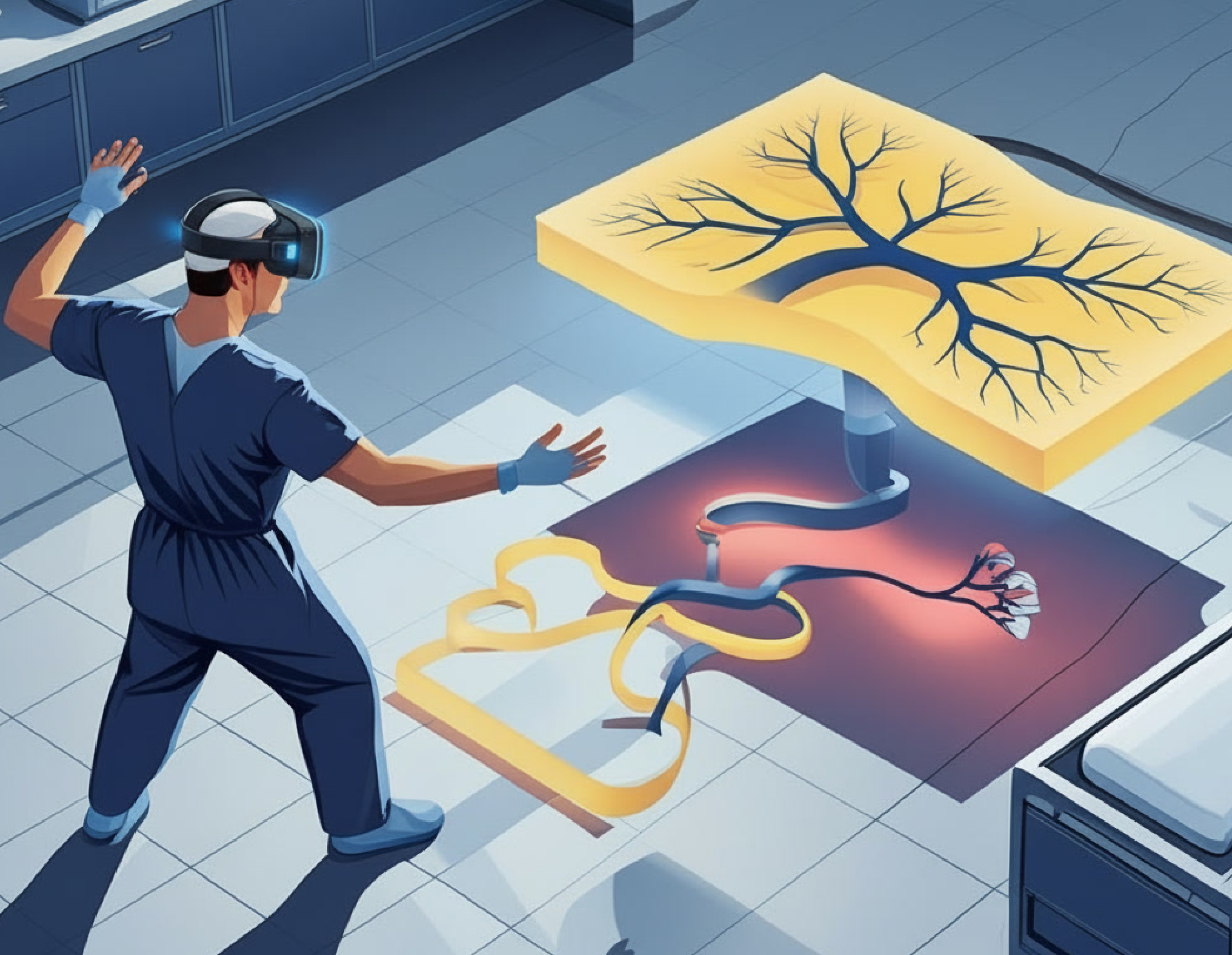
A child who is terrified of needles becomes so absorbed in a virtual world that they barely notice the vaccination happening. A stroke patient no longer has to monotonously repeat the same arm movement, but instead lifts a virtual sword to fight a dragon. And in the operating room, a surgeon can see digital anatomy aligned with the patient instead of constantly switching attention between the body and flat 2D scans.
Virtual reality and augmented reality are already being used in medicine today — not as a concept, but in real clinical settings. They help reduce pain, support rehabilitation, train clinicians, assist during surgery, and make medical procedures less stressful for patients.
But the field is far from uniform. Some use cases are supported by strong data and everyday practice, while others are still being tested. And even when the results look convincing, hospitals still have to deal with very practical issues — cost, integration into workflows, side effects, and staff training.
In this article, we look at where immersive technologies are already helping patients and clinicians, where the evidence is strongest, where the hype still runs ahead of reality, and why hospitals still do not use VR and AR nearly as widely as the headlines might suggest.
What VR and AR mean in medicine
The FDA describes Virtual Reality (VR) as an immersive virtual world experience that usually requires a headset to fully replace the surrounding view with a simulated interactive environment.
Closely related is Augmented Reality (AR) — the real world with digital overlays, where data or images are added on top of reality through a camera or display, such as a smartphone or glasses/HUD.
In clinical practice, VR is especially useful because it creates a controlled environment. Doctors can use it to redirect attention away from pain, train staff without putting patients at risk, or guide patients through immersive rehabilitation exercises.
It is also important that the regulator explicitly lists the areas of AR/VR application in medicine — from pain management and mental health to surgery planning, intraoperative procedures, telemedicine/virtual care, and rehabilitation.
How VR helps with pain and stressful procedures
When it comes to pain, VR often works in a simple way: it helps distract the patient, so the procedure feels less painful and stressful. That is especially valuable when doctors want to reduce medication use wherever possible. A large review on pain management, including a total of 274 studies and 17,680 patients, reported benefits of VR for pain control in different contexts (perioperative, periprocedural, chronic). This approach to pain relief requires neither injections nor pharmacological drugs.

VR occupies channels of attention and emotion in such a way that subjective pain and anxiety are reduced during burn dressing changes, invasive procedures, labor, and more. Even children who are usually very anxious about needles can become so immersed in virtual worlds that injections feel much less distressing, for example during vaccinations or blood draws.
It can help patients relax and better manage how they experience chronic pain. In 2015, researchers created a VR system that responded to the patient’s stress level in real time: for example, the fog in the scene could become thicker and the sound less clear. This gave people a simple way to notice their own tension and learn to calm themselves down.
The shift from clinic to home is one of the most notable changes, as it alters both the economics by reducing visits and the scalability by expanding patient reach. An illustrative example is a study of an 8-week home VR program for chronic low back pain. The analysis included 1,067 participants, and the VR group performed statistically better than the sham group in reducing pain intensity and pain interference by day 56, with the changes assessed as clinically meaningful.
From repetitive exercise to gamified rehabilitation
VR rehabilitation is training delivered through recognizable everyday scenarios. For example, the FDA explicitly cites VR rehabilitation therapy as an approach in which a patient after stroke practices movements in a simulation of real-life situations in order to restore physical function. In one study, people after stroke prepared food and put groceries away in a virtual environment, working specifically with the affected arm; the system prompted actions with visual and auditory cues, and points were displayed on the screen for effective performance. At the same time, developers are making rehabilitation more game-like. In one example, the patient raises the affected arm as if lifting a sword to fight a dragon. Instead of the dull exercise “raise your arm 20 times,” the patient is given a meaningful task with a goal, feedback, and a sense of progress.
Another vivid example is virtual shopping as training not only for motor skills, but also for memory, attention, and planning. In a study, stroke patients had to memorize a shopping list and a route, then in VR take the elevator down, find the right bus, ride to the store, select the items, pay for them, and return home. The difficulty changed automatically: if the person completed the task without errors, the system increased the number of items to buy. At the end, the performance results were displayed.

Can VR reduce anxiety before medical procedures?
VR can also help before surgery, when anxiety often peaks most sharply. For many patients, the worst part is not the operation itself, but the waiting: fear of anesthesia, uncertainty, strange equipment, and the feeling of losing control. VR helps make that moment more manageable. In some studies, patients were taken on a virtual tour of the operating room and recovery area before surgery, so they could see in advance what would happen and what the environment would look like. Other approaches used immersive distraction or calming content chosen by the patient. Across 26 randomized trials with 2,357 adults, such VR interventions were associated with significantly lower preoperative anxiety than usual care.
What augmented reality looks like in the operating room
In the operating room, it is AR-based approaches that are more commonly used: the surgeon wears a headset into which a virtual surgical plan is loaded based on the patient’s CT or MRI, and this 3D layer is then aligned with the real anatomy directly on the table. For example, in maxillofacial surgery, such systems were used for orbital fractures and reconstructive interventions: after registration using anatomical landmarks, the physician sees bone contours, critical structures, and the area where the implant should be placed overlaid directly on the patient. This improves orientation, enables more precise localization of the target area, and reduces distraction from separate 2D monitors.
How VR is changing medical training
In medical education, VR can reduce training risks and make learning more engaging. Virtual reality helps visualize the nuances of core medical sciences for students — anatomy, physiology, and even how the body functions at the level of individual cells — as well as understand complex highly specialized interventions, such as certain orthopedic procedures on the knee joint. One example is Osso VR, a platform for practicing surgical skills in a virtual operating room format, where the user goes through a procedure step by step, works with instruments, and learns in a safe environment before entering the real clinical setting. Research has shown that surgeons after VR training performed a training operation (tibial intramedullary nailing) faster than the group that studied the method in the traditional way and required fewer corrections during the procedure.
A large systematic review and meta-analysis in healthcare education included 45 studies and showed statistically significant improvements in knowledge, skills, as well as increased learner satisfaction and confidence.
For surgical skills, VR simulators are especially useful where learning on the patient is ethically and organizationally impossible. Studies of VR training for laparoscopic cholecystectomy showed improvements in technical performance and reductions in operative time compared with no additional training.
In addition to surgical procedures, VR helps teach standards of therapeutic patient examination and even nursing skills such as cleaning/disinfecting equipment and administering injections.
In healthcare, VR can also be applied at a global level. In January 2024, the World Health Organization reported on a VR tool for ship sanitation inspection training, first tested during training in Istanbul. The potential for remotely training inspectors through VR simulations was also emphasized.
Why hospitals still do not use VR everywhere
However, good research results do not automatically mean mass adoption in hospitals. According to a review of more than 5,000 studies, clinical VR is still at an early stage: interest in it is high, but systematic implementation is progressing much more slowly. In practice, VR adoption is hindered not only by financial costs, but also by routine realities: physicians and therapists need time to master the system, clinics need to allocate space, technical support, and equipment, and the technology itself must fit into the existing treatment process rather than disrupt it. Additional challenges include hardware and software failures, the lack of unified protocols, weak personalization for a specific patient, possible discomfort when using a headset, and the fact that it is not always clear who covers the cost of VR.
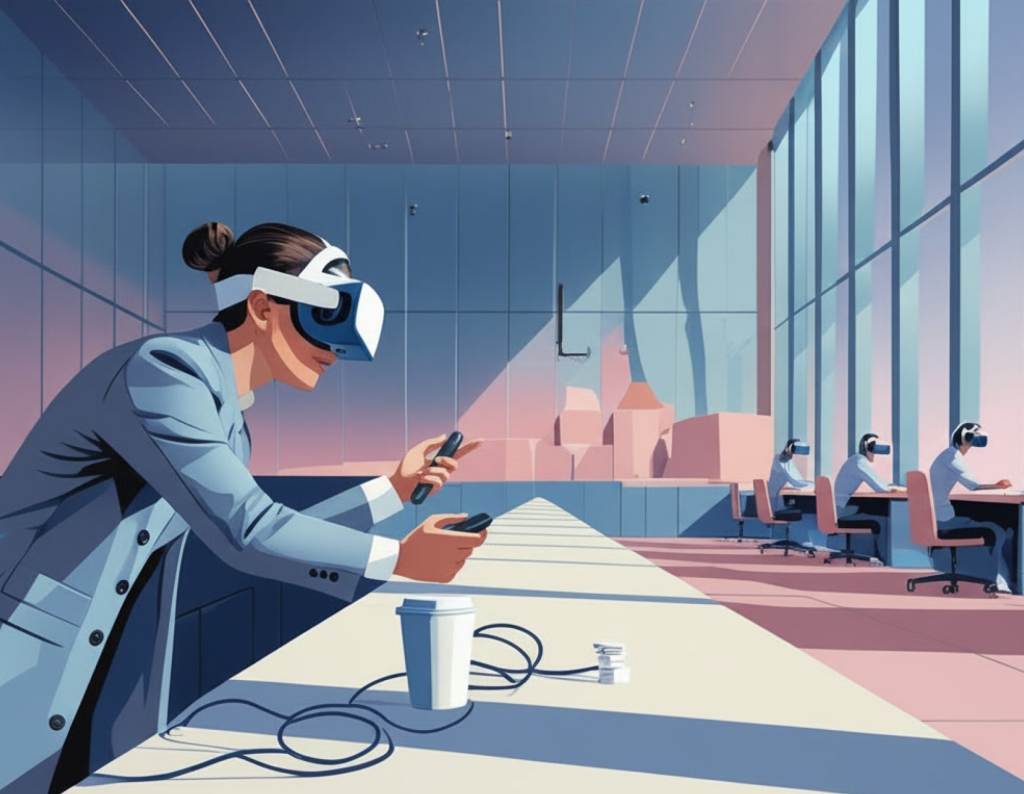
Additionally, AR/VR devices still carry certain risks: from physical strain (for example, neck pain caused by headset weight) to content/image-related problems (display errors, information overload), as well as dizziness, fatigue, and effects on vision; cyber-security and privacy risks are also noted separately, and in the operating room there is the risk of distracting the surgeon from the surgical field.
VR side effects are usually grouped under the term cybersickness. Disorientation is most common with head-mounted displays, followed by nausea and oculomotor disturbances. Therefore, a VR intervention still cannot be designed as a universal tool. Age, vestibular sensitivity, cognitive limitations, and the procedural context must all be taken into account — factors that are also identified in implementation studies as significant barriers and determinants of patient suitability.
What comes next for VR in healthcare
The future of VR in medicine is associated with more convenient spatial interfaces, home rehabilitation, educational simulators, and the integration of VR with AI. According to forecasts, physicians will increasingly use VR/AR as a working interface, for example for surgical navigation, 3D visualization of anatomy, or rehearsal of a procedure before intervention. The FDA already maintains a separate list of AR/VR medical devices, including solutions for visualization and navigation as well as therapeutic products.
Virtual simulators are also a way to train larger numbers of people more quickly and safely. Instead of waiting for a rare clinical case or learning immediately on a real patient, a student or junior physician can practice intubation, arthroscopy, or an emergency algorithm dozens of times in simulation and arrive in the clinic already equipped with basic motor and cognitive preparation.
Finally, the VR + AI combination is becoming increasingly visible. In education, this means more lifelike virtual patients who can react differently to a student’s actions, change symptoms, and make the scenario more complex depending on the student’s decisions. In therapy, it means more precise adjustment of workload: for example, the system can automatically make rehabilitation exercises more difficult if the patient is coping consistently well, or reduce intensity when signs of fatigue appear. But this is precisely where issues of privacy, bias, and trust in algorithms become especially important, so the development of such solutions will go hand in hand with stricter requirements for ethics, cybersecurity, and data governance.