



The word “rejuvenation” covers everything from cosmetics and supplements to lab work that tries to change how cells age — and, in turn, how age-related disease risk builds up. This article is a short guide to the science-backed version of that conversation: what geroscience is, what the Hallmarks of Aging are, and why investors are pouring billions into the space.
Geroscience focuses on the molecular and cellular processes that make aging a major driver of chronic disease — and on ways to intervene. The goal here is rarely immortality, it’s healthspan — the period of life spent in good health, free from the chronic diseases and disabilities of aging.
Hallmarks of Aging: A Map of Why the Body Ages
In 2013, researchers introduced the Hallmarks of Aging framework — a practical map of recurring types of damage and dysfunction that accumulate with age and drive decline.
Ten years later, this map was updated: in the 2023 version, twelve hallmarks are proposed. Advocates argue that targeting these hallmarks could do more than slow aging — it could support broader rejuvenation.
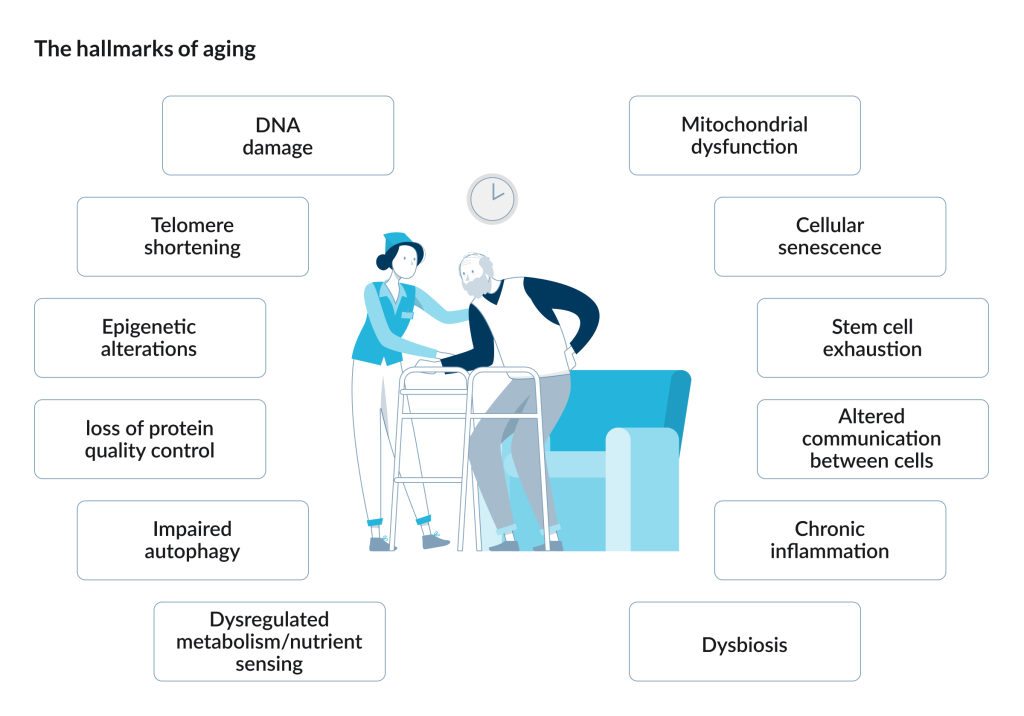
The hallmarks include:
– DNA damage;
– telomere shortening — protective caps at chromosome ends get shorter;
– epigenetic alterations — changes in gene activity;
– loss of protein quality control;
– impaired autophagy — cells recycle damaged parts less efficiently;
– dysregulated metabolism/nutrient sensing;
– mitochondrial dysfunction — the cell’s power stations;
– cellular senescence — cells stop dividing but remain and can harm tissues;
– stem cell exhaustion;
– altered communication between cells;
– chronic inflammation;
– dysbiosis — changes in the microbiome.
Rejuvenation Tactics
Rejuvenation research usually targets one or two specific bottlenecks: clearing senescent cells, restoring mitochondrial function, improving cellular cleanup (autophagy), or shifting epigenetic state. Companies rarely market this as rejuvenation. They present it as therapies for age-associated diseases — heart disease, neurodegeneration, cancers, and others that become more common with age.
For example, animal studies suggest that targeting senescent cells, using partial cellular reprogramming, or restoring specific signaling pathways can reverse some physiological and cellular features of aging (mostly in mice). Dozens of clinical trials are underway testing therapies aimed at the Hallmarks of Aging.
Large Companies and Entrepreneurs Investing in Rejuvenation
The most visible players in rejuvenation are biotech companies building platforms or drugs aimed at specific age-related diseases. Here are a few examples:
Calico Life Sciences (by Google). A long game on age-related disease
In 2013 Google announced the launch of Calico as a separate company focused on research into health and aging.
Calico largely follows a classic pharma playbook: long-term basic research, then drug candidates, then clinical programs focused on specific diseases. According to a review in Nature Reviews Drug Discovery (December 2025), over the years Calico has advanced several of its compounds from laboratory research into human trials and continues to develop new medicines for age-related diseases.

Alphabet also owns Isomorphic Labs (a DeepMind spinout). It’s best thought of as a bet on AI-driven drug discovery in general, not a company focused specifically on aging. The company uses AI models built on and beyond AlphaFold to predict biomolecular structures/interactions and design new drug molecules faster, aiming to accelerate the creation of new medicines.
Altos Labs. Cellular reprogramming as the core idea
Altos is one of the most high-profile bets on the direction of partial DNA reprogramming and cellular rejuvenation. At launch, the company announced its mission as restoring cellular health through cellular rejuvenation programming (in simple terms: reprogramming for cellular resilience and youth).
Altos launched with unusually large funding; public reports often cite roughly $3 billion. The same reporting links the project to high-profile backers, including Jeff Bezos and Yuri Milner.
Retro Biosciences. Automation and AI-first biotech
Retro was initially positioned around a very specific goal — to add 10 years of healthy life by targeting several Hallmarks of Aging. Its distinctive feature is a strong emphasis on computational methods and laboratory automation. That emphasis makes sense: one of its investors is Sam Altman.
In August 2025, OpenAI published a piece about its collaboration with Retro, describing a model for protein design and improving the efficiency of substances that enable the reprogramming of adult cells into a more youthful state.
GERO. Finding targets in real-world human data
Using large-scale real-world human medical data, Gero identifies therapeutic targets in aging biology and then works with partners to translate those targets into drug candidates. In July 2025, Chugai (a member of the Roche Group) officially announced a joint research and licensing agreement: the platform contributes target discovery, while Chugai develops antibody candidates to translate those targets into potential therapies.
On its site, the company describes the approach as AI-driven and grounded in human data, with physics-based modeling.
And this is only a slice of the field. The bigger picture is a fast-growing mix of biotech, AI platforms, and early clinical attempts — with very uneven evidence across projects.
The Future of Rejuvenation: Breakthroughs and New Challenges
Because the topic of rejuvenation is emotionally charged, it inevitably generates a market of services that outpace the evidence. Sometimes this is simply useless, sometimes dangerous, and sometimes it diverts resources and trust away from real science. Big money keeps flowing into aging research, accelerating studies, platforms, clinical efforts, and infrastructure. But charlatans have not disappeared — under the guise of rejuvenation remedies, they will continue to sell ineffective or even harmful products to trusting individuals.
On the other hand, if companies working on rejuvenation technologies achieve real success, humanity may face many new challenges in the coming decades, but also the resolution of problems that have been with us since ancient times.