



Should I move to a different country? To boost my career, to pursue more interesting work and a higher salary, or simply to escape a war zone? Not long ago, the world was converging, and software engineering was a tailor-made profession for a globalizing humanity: decent pay, freedom to choose between cities, countries, and projects at will. But the rules are changing at breakneck speed. The future that IT specialists were counting on looks different now — fragmented, uncertain, and in some places, dangerous.
IT workers remain one of the most agile layers of modern society. So what does that mobility look like today? We explored this in a recent conversation with our guest — Global Relations Director at Anderson, economist, former diplomat, a person who has first-hand experience in immigration — Dr. Kiryl Rudy.

Lidziya: Сan you tell us a bit more about yourself? Where are you now physically and professionally?
Dr. Rudy: I’m currently based in Charlotte, North Carolina, United States.
The U.S. is a huge, fast-moving market. It has a lot of advantages. One of them is supported by strong defense, best universities, capitalist culture, and freedom to attract talents.
I work with Anderson Lab, where we’ve done some big projects together and are still chasing some. Sometimes I act as the brand ambassador. We jointly work on some media projects like this.
Lidziya: Let’s go into historical data, which shows that traditionally, big technical hubs attracted skilled IT workers. This trend held at least until the pre-COVID times.Then we had two major blows, like COVID and the rising number of armed conflicts. Does it change that decade-long trend?
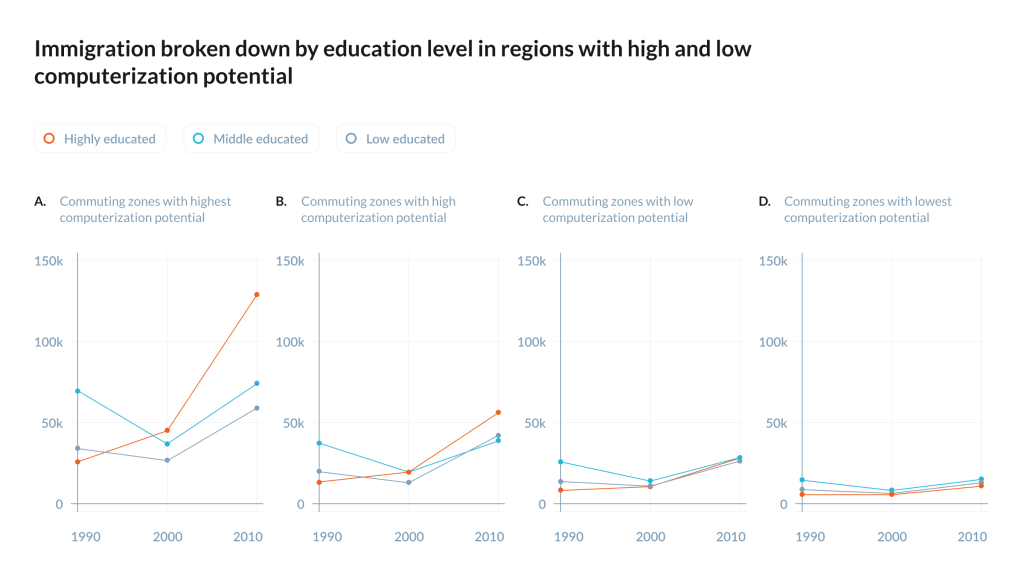
Source: “How computerisation is driving the immigration of highly skilled workers”,
KOF Bulletin, KOF Swiss Economic Institute, ETH Zurich, September 2022.
Dr. Rudy: Well, I would like to outline three things here.
First, we all live in our own information bubble. Let’s not overestimate immigration, because only 4% of people live outside their home countries. If you look at the tech migration, it’s also only 4% of all immigrants. About the same share as the overall labor market of tech specialists. So, even there is a rise for tech immigrants, but to the global market, it doesn’t mean a lot. Second, yes, you’re right that within high-skilled immigration, there are a lot of tech specialists.
There is a large share of them. Sometimes it’s up to 60%. And that’s why a lot of governments focus their state talent programs on IT professionals.
And high-skilled immigrants are mostly legal. And you can ask any immigrant what is the most important — everyone says that it’s a legal status. Tech immigrants have some advantages.
And the third thing, yes, COVID, geopolitics, political issues, they all shape immigration recently. Especially for programmers from Ukraine, Russia, and Belarus.
But even though these big geopolitical events caused migration, people still did not move far. They just crossed the border — from Ukraine or Belarus they went to Poland — to Eastern Europe, rather than far countries.
Lidziya: If we look globally, where are IT workers going? What are the global attractors for such kinds of people?
Dr. Rudy: First of all, Western countries — the United States, Canada. In Europe, I would say it could be the UK, Portugal, Spain. Why these countries? Because there is demand for IT specialists due to cybersecurity concerns.
Many Western clients prefer on-site personnel. So, if you want to work with them, you need to move to them.
And also, it’s the countries with high standards of living. Software engineers are moving with their families. They want their kids to go to good international schools, have a safe environment, and strong universities. That’s the main two reasons why they go specifically to the Western countries.
Lidziya: And who’s losing people? It is understandable that people leave Ukraine because of the war. But are there any not so evident patterns? Who are the main donors of the IT workforce?
Dr. Rudy: Well, IT talent is especially sensitive to problems at their homes. So, they are often among the first to leave.
If you look at the largest countries where IT specialists are moving from, it’s first of all Mexico. Where security issues like drug cartel violence pushed many IT specialists to move to the United States. India is just the biggest IT hub. And because there are a lot of IT tech specialists we see a lot of tech immigrants from India. There is also a big move from China. They’re chasing good education, career opportunities. I would say they’re chasing the American dream and going to the United States. Across Russia and neighboring countries, we can see that many IT professionals have relocated due to political pressure, due to war and increasing Internet restrictions. But surprisingly, in recent years, like in the last two or three years we can see a new trend that we’re facing now — big flows of immigrants from one Western country to another Western country.
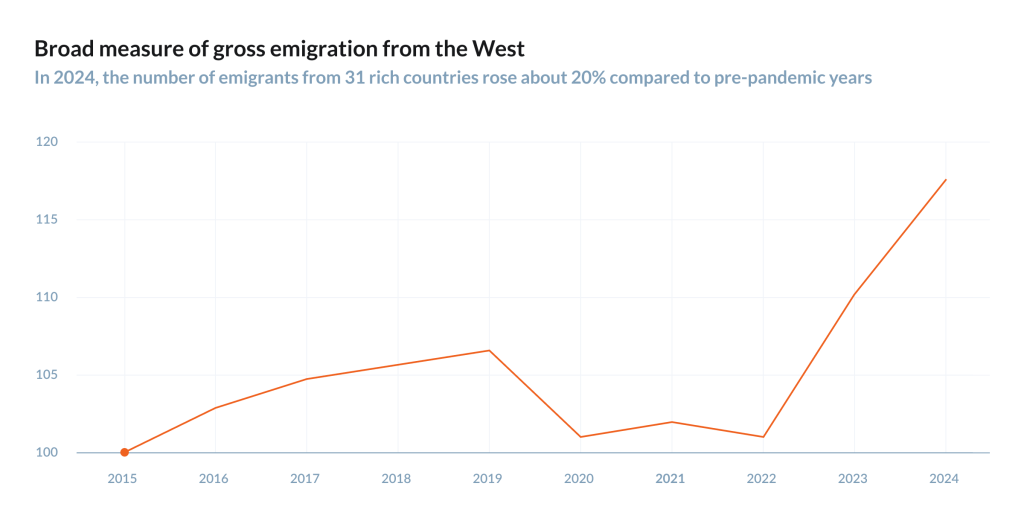
In 2024, the number of emigrants from 31 rich countries rose about 20% compared to pre-pandemic years.
Source: “Westerners are fleeing their countries in record numbers”,
The Economist, Finance & Economics, March 28, 2026
Lidziya: Let’s talk about driving forces. Is it taxes? Is it the rise of unexpected technical hubs? What attracts people in terms of incentives?
Dr. Rudy: I would say that moving is kind of a natural instinct for some people. So, if they relocate within a country, it makes sense to just cross the border.
There are at least three main reasons why people leave their homeland. The first one is personal safety. Nobody wants to leave their home until they feel threatened.
There are some risks. They feel unsecure. So, they try to find a new environment like this.
Political pressure is among these reasons for personal safety. And we can see in those countries where democracy declines, people leave. And immigrants are the people that, on average, are more democracy-oriented than those who stayed behind.
The second reason is real income. And here, this tax that you mentioned. Currently, we see a lot of Western countries implementing such so-called Robin Hood tax policies — let’s tax the rich. And if a software engineer becomes senior, becomes rich, they do not like high taxes. So, they start moving away, even from the Western countries. Previously Dubai was the main destination, now, they have different situations. But try to find the tax havens.
Usually, people go abroad for a job. It’s not like we try to find a job where we live. Usually, we try to live where we find a job.
And tech hubs, visa policies, a lot of sometimes broad social openness. Because before, immigrants were mostly male-dominated. Now, we see more women in tech.
We see more women in big professions. So, that’s why they also start moving and become more like immigrants.
Lidziya: There also must be something which pulls people towards their roots, like family ties.
That’s also very natural for people to be homebound. Is anything changing within that pattern, within factors that keep people in place?
Dr. Rudy: Well, usually, if everything is good at home, nobody wants to leave.
So, there is a lack of incentives, lack of risks, lack of threats. That’s the main reason why people don’t want to go. Another big reason or barrier why they don’t want to go, it goes back to the lemon theory of an American economist called George Akerlof.
And he used his theory in the secondary automobile market. When you want to buy a second-hand car, you usually go to your friends, because they will not lie to you. You try to buy this old car through your friends, not through the open market.

So, the same logic is for immigrants. They want to find the connections, the friends who will recommend them something, better schools, better jobs. Nobody wants to investigate on their own, and they’re afraid to make mistakes.
And again, practical barriers are people sometimes just don’t have money to move. They’re afraid. They overestimate the risks.
Sometimes they say, well, social security is poor, the health system is unpredictable, and something that I don’t like. In general, they don’t want to change their lives. They don’t want to change the status quo that they have.
So, if you have this adventurous spirit, sometimes if you don’t have it, that would be a barrier.
Lidziya: When I was getting ready for this call, I was surprised how many countries proposed something like golden visas, digital nomad visas. Can we go through the landscape of those programs existing now?
| Country | Program Name | Tax Treatment | Duration & Renewals | Path to PR / Citizenship |
| Spain | Visado para Teletrabajadores | “Beckham Law”: 0% on foreign income, 24% flat on Spanish earnings up to €600k — up to 6 yrs | 1-yr visa → 3-yr permit + 2-yr renewal (5 yrs total) | PR after 5 yrs |
| Portugal | D8 Remote Work Visa | IFICI/NHR 2.0: 20% flat on PT income; broad foreign-income exemption — 10 yrs | 1 or 2-yr permit, renewable up to 5 yrs | PR after 5 yrs or citizenship after 5 yrs |
| UAE | Virtual Working Programme | 0% personal income tax — no exceptions | 1 yr, renewable indefinitely | No conventional PR; Golden Visa available separately for AI/tech experts |
| Hungary | White Card | 0% under 183 days; 15% flat if tax resident | 1 + 1 yr (2 yrs max) | PR only via full permit category switch after 2 yrs |
| USA | EB-2 NIW (STEM Green Card) | Standard US progressive tax | Permanent from day 1 | Immediate green card |
| USA | EB-1A (Extraordinary Ability Green Card) | Standard US progressive tax (federal 10–37%; state varies) | Permanent from day 1; self-petition via I-140 (premium processing: 15 business days for $2,965) | Immediate green card — permanent residency; citizenship after 5 yrs |
| USA | O-1A (Extraordinary Ability Nonimmigrant Visa) | Standard US progressive tax; full US tax resident after 183 days | 3-yr initial + 1-yr extensions (unlimited renewals); no annual cap or lottery; premium processing in 15 business days | Non-immigrant visa — no direct PR path; widely used as a stepping stone to EB-1A green card |
| Canada | Global Talent Stream (GTS) + Express Entry STEM Category | Federal + provincial progressive tax; combined effective rate ~30–53%; Ontario top marginal rate ~53.5% | Work permit processed in ~2 weeks, valid 2 yrs, renewable; PR via Express Entry STEM draws: ~6 months | PR via Express Entry after gaining Canadian work experience; citizenship after 1,095 days in any 5-yr period |
| Finland | Talent Boost Programme (employer-sponsored specialist residence permit) | Progressive income tax; effective rate ~30–45% for IT workers; top marginal rate up to 51.4% | First permit 1–2 yrs (employer-tied), renewable; fast-track processing 10–14 days via Business Finland | PR after 4 yrs; citizenship after 5 yrs continuous residence |
Captions: listing of countries and active programs for relocation (2026). List is not exhaustive.
Dr. Rudy: Absolutely. That’s a very common long-term logic of any tech specialist who moves abroad. So, he looks at these programs, like one link in the big chain: how to get permanent residence in the country, and how to get a new citizenship also in a new country where he moves.
So, different countries offer different programs. Canada provides an express entry system where no job offer is required in many cases. In the U.S., there are a lot of talent programs like B1A, O1. Even for Taiwan, for Chinese programmers, there is an employment gold card. In Finland, fast-track residence permits. In Portugal, Spain, Estonia, and the United Arab Emirates, where I just moved from the UAE, they have golden visas and a tax-friendly regime.
But the UAE, on the other hand, has a very limited path to citizenship. And everyone understands that even though you stay there for a long time, you will never become a citizen.
Lidziya: It feels like before all that war period, that thing with obtaining residentships was not so important for IT workers. People were thinking: “I will go for work and I will return in 5-10 years”.
And now people are really looking for permanent residency and it becomes even more important than taxation and other factors in those programs.
Dr. Rudy: Absolutely. It used to be a short-term vision and people didn’t think about this new era for a long term. Everyone thought, okay, let’s go back to 2019 before the COVID times and everything will be the same. But every year the values are changing and everybody wants long-term stability.
They want to have defense and so on and so on. So, that’s why it’s rather important to get a long-term vision.
Lidziya: When IT workers or any people migrate, they still maintain dual lives. They raise their kids who know from the very beginning at least two languages. Are we tracking the second order effects of such movement of people?
Dr. Rudy: That’s a very important question. Second order effects depend on where you’re moving. And I’ll give you several examples here.
The first case is Finland in 1947. Finland gave part of their territory to the Soviet Union. So, it had to relocate 430,000 citizens. And in 25 years, many of those relocated groups have become on average more prosperous, better educated. So, that proves that even within one country people are moving, it’s better for the next generations. But you may argue that it’s only one country.

Another case is Germany. When in 1941 Germany attacked the Soviet Union, Stalin forcefully relocated to far regions a lot of ethnic Germans. He relocated them to Kazakhstan, to many other countries, to many other far east places in the Soviet Union.
And by the 1950s, their incomes remained limited. They didn’t have any advantages because they have restrictions on work. They cannot move to other places.
They cannot take some positions at work. And only in 1991 when Chancellor Helmut Kohl came to power and the Soviet Union broke up. So, there were special programs on how to repatriate of ethnic Germans from Kazakhstan to Germany.
They provided them with social support, integration programs. And over time, we can see now their kids became better educated with the high income levels. So, my key takeaway here is that it depends where you move rather than the movement itself.
Lidziya: Okay, all those factors like visas, taxes, now getting on the backdrop of a very important factor which is AI. It eats out of the job itself. What does AI do to the market? How will it affect migration patterns?
Dr. Rudy: Well, actually, we should be very cautious in our evaluation of AI because still by now we don’t see reputable and good research that proves that AI takes jobs. We see some cases and also we don’t see any research like very high-ranked research that proves that AI can influence migration.
So, we see that big companies are firing people and they say it’s because of AI. But on the other hand, we see why they’re firing. They’re firing people because they want to save money to invest in AI.
It’s not that AI replaces people. It’s just that banks are reluctant and don’t want to give the loans anymore to these companies because these companies don’t show a high rate of investments from AI. So, that’s one of the reasons why we see that people are fired, but AI probably is not the main reason.

Another important thing is that AI is widespread mostly in Western countries, which mostly rely on outsourcing of IT. So, in that sense, AI is most likely to replace offshoring models and will focus on on-site roles in the near term. And finally, this impact depends on the tech skills levels, industry competence and who are those immigrants, what kind of roles they play and how do they perform in the AI-driven automation.
Lidziya: I have a story, not actually a single story, which says that there is something definitely changing.
There’s a development team who developed an application MamaAir, a startup which builds tools to help women navigate health risks from air pollution and climate. They started in Europe, they developed their AI-based technology and gradually understood that regulations are too heavy. Time-wise, cost-wise, they are not able to keep up and part of their team moved to Africa, not because the development was too difficult, but because of the regulations and stuff around the development.
Five years ago that would have sounded bizarre and now it feels like a pattern.
Dr. Rudy: I agree, this case just proves the common rule and the research that we made in Anderson Geotech LinkedIn page. We did some research trying to investigate how to analyze the factors like age, education and income. Definitely Africa is the continent with the lower income, with the younger age and comparatively relatively poor education.
But our analysis shows that in more educated, high-income countries, older countries tend to be more exposed to AI in tech and business roles. And if you look at the countries that are more risky and AI from our perspective is Poland, it’s the Czech Republic. And the countries that are less sensitive to AI, that’s exactly what you mentioned, it could be Nigeria, it could be Bangladesh, Mexico, Romania.
China is a separate case, it’s something that I investigate separately, because it’s a huge market and China is different, because China uses AI in everyday life. So, it’s not something rocket science like for many other countries, it’s like everyone in the school, in the hospitals, in the restaurants, in hotels, everyone can use AI. However, for immigrants it’s a less attractive market because there is huge competition in AI.
And currently we can see the data that now we see more and more AI scholars from China than even more than from the United States. And the recent data from the economists prove that.
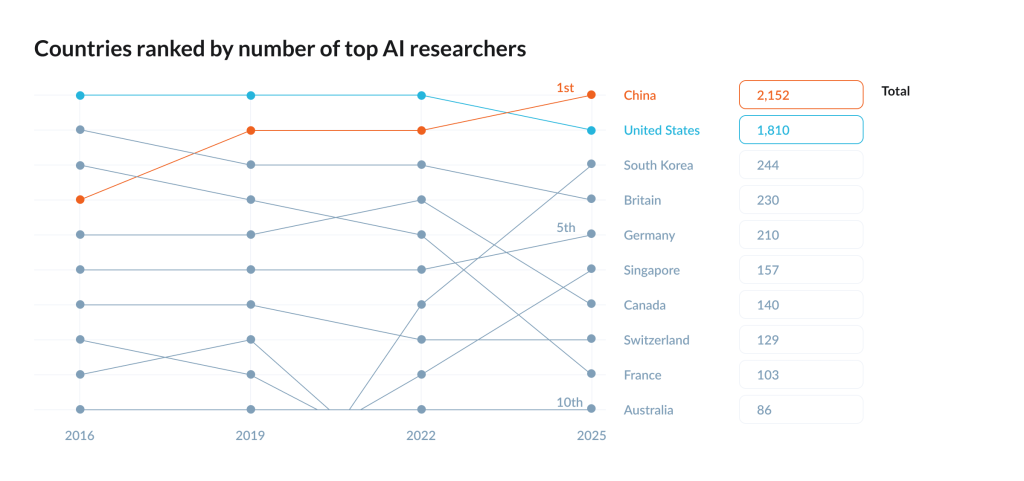
Sources: “Emigration: The expat economy”, The Economist, March 28, 2026
Lidziya: Who is the most geographically exposed right now? Which workers, which regions face the biggest displacement risk due to AI?
Dr. Rudy: We could say that the most sensitive continents and countries are those that invest a lot in AI.
They were the first who would get these challenges that we will see in other countries. So, the poor countries, the countries with the less educated and younger population who have less demand for AI, they probably will come to those problems later. So, it’s a good chance for those who want to run away from AI to go to those countries, spend some time there and wait when the AI gets there as well.
But we should not just fool ourselves, in order to be competitive we should use this time to get educated and to integrate AI in our work and life. While in the Western markets, this competition is unraveling very fast.
Lidziya: Do you have data on how markets are changed when a lot of IT workers move in? What’s going on with the local job markets of accepting countries?
Dr. Rudy: Well, at least I would say 100% there is no negative effect for the local markets. Immigrants, tech immigrants, don’t steal jobs, they don’t affect the average salary. And the proof, there was a widely cited research by David Card that he published in 1999, he investigated how Cuban immigrants affect Miami and he showed no negative effect. So, this has already been proven many years ago.
We can even see a positive effect — like 25% of all high-tech startups are founded by immigrants. And roughly half of all US unicorn companies have at least one immigrant founder.
We know examples like Elon Musk, Sergey Brin, Steve Jobs are immigrants. Henry Ford, he came from the Ireland immigrant family. So, everyone in the US who succeeded this way or another is connected with immigration.
From the broader perspective, if you look at the local market of the country, where these immigrants are going from. So, definitely this local market hurts most. Even if you see tech specialists, or not tech specialists — a doctor or a teacher who leaves his own town and moves to New York and works as a bartender.
We could take a bartender as an example of a less skilled job compared to the doctor in his own country. So, if his salary is higher in New York, that’s good for the global economy. It’s bad for the local economy where he comes from, but globally it gives value added and it gives more money for the global economy and we all at the end get benefit from that.
Lidziya: You look at all that data, you study labor models, displacement curves. How does this knowledge influence your own work? What does it mean for you to do something that matters?
Dr. Rudy: I lived in China for 10 years, I lived in UAE, now in the US, Belarus as well, I’d say culture matters. Culture matters, but core values and human nature are largely universal. People are more or less similar.
They want the same things for their kids, the same things for them. So, I don’t see a big difference among people. Of course, the biggest challenge that I face and I see when I talk with other immigrants is about parents who don’t want to move from their home.
And here, it reminds me of the movie, Sophie’s Choice, when you have to make this hard choice, okay, for the future of the kids, you need to relocate. But it’s not something, it’s not the preference, it’s more, I would say, this choice is shaped by some restrictions, some circumstances, rather than your just new desire to move. And what influence, what does it mean to do something that matters?
I would say that, like for immigration, the main motive is the same for the work, it’s not the money. It’s something that you can see that bigger things are happening. But definitely, money is important and you cannot do anything without the money.
That’s obvious. But you get satisfied not with your bank account, just with the facts, how you spend your money, how you, you know, change the mindset, I would say. That’s the most important thing, to be adaptive.
And now we will talk about not IQ, but about AQ, how to adapt yourself. And if your work can help people to adapt and can help people to live longer, I would say, that’s probably the main meaning of everyone’s job.