



A typical day in the emergency department. A patient comes in with chest pain, and there is little time to spare. The physician opens the patient’s chart and, within seconds, sees previous ECGs, a medication list, allergies, lab results, a CT scan, and notes from a cardiologist at another clinic. For the physician, it is just a screen. For the IT team, it is a complex chain of medical systems, storage, data exchange standards, access controls, and backups.
In the past, most of this data was stored on a hospital’s own servers in a dedicated room. Today, the cloud is increasingly taking over that role. Cloud computing in healthcare means using secure cloud services to store, process, and exchange medical data: patient records, imaging studies, lab results, telemedicine consultations, and research datasets.
Cloud computing provides on-demand access to computing resources: servers, storage, applications, and services. A hospital does not have to buy all the hardware itself. It can rent the capacity it needs and scale it as the volume of data grows.
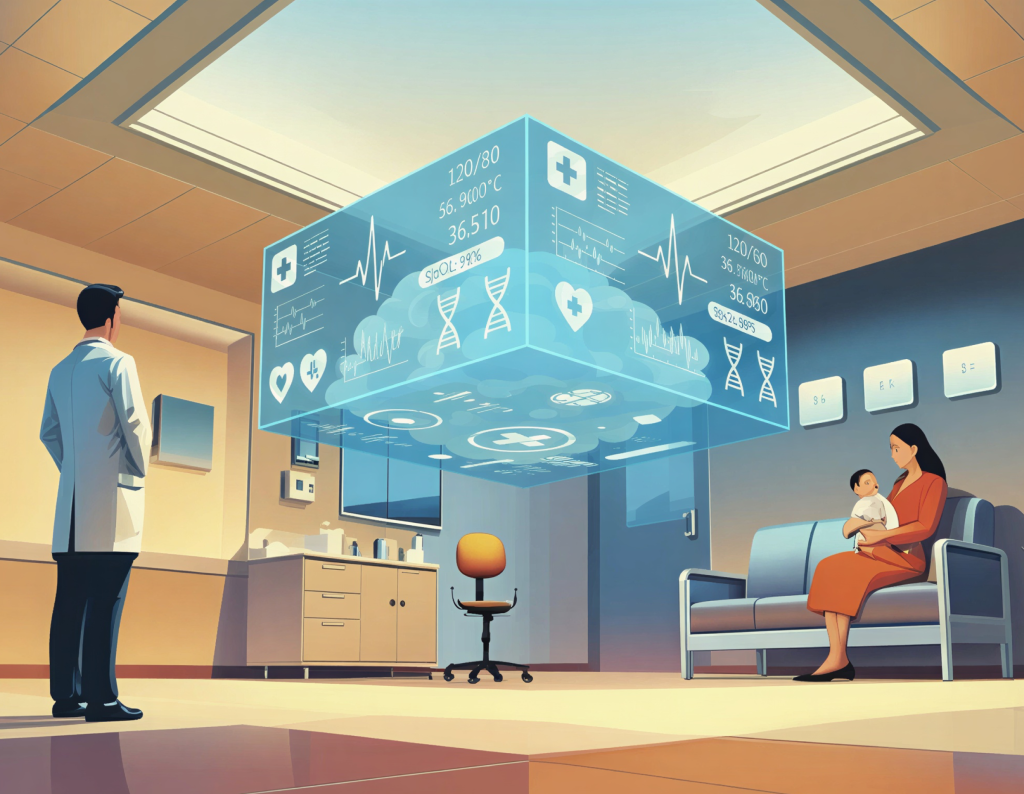
What is cloud computing in the healthcare industry?
Imagine a patient has a CT scan at one center, lab tests at another, receives an online consultation, and is then treated in a hospital. The physician making clinical decisions needs to see the full picture in one place. The cloud helps collect this data, store it, protect it, and move it between systems.
Among the key priorities in digital health, the WHO highlights data exchange standards and tools that support more informed medical decision-making.
A short glossary to understand the topic
| Term | Meaning |
| Cloud | A network of large data centers where data can be stored and software can run |
| EHR / EMR | A patient’s electronic health record |
| DICOM | A standard format for medical images: CT, MRI, X-ray |
| FHIR / HL7 | “Languages” that medical software uses to exchange data |
| AWS, Azure, Google Cloud | Major cloud platforms from Amazon, Microsoft, and Google |
| HIPAA | A U.S. law governing the protection of health information |
| ePHI | Electronic health information that can identify a patient: diagnoses, lab results, prescriptions, insurance data |
Types of Cloud Computing
Healthcare organizations usually use one of four types of cloud systems.
| Cloud type | Explanation | Healthcare example |
| Public cloud | A hospital uses the infrastructure of a major cloud provider | Image storage, telemedicine, analytics |
| Private cloud | The cloud environment is dedicated to one organization only | A large clinic network stores highly sensitive data |
| Hybrid cloud | Some data remains inside the hospital, while some is moved to the cloud | Legacy systems run locally, while new services run in the cloud |
| Multi-cloud | Several cloud providers are used | For example, one system runs on Azure and another on AWS |
There is also the U.S. HIPAA law, which regulates how healthcare organizations must protect patient data. If a U.S. hospital transfers medical data to the cloud, it must sign a special agreement with the provider and conduct a risk assessment. A cloud provider becomes a “business associate” if it stores or processes electronic protected health information, or ePHI.
How cloud computing is used in healthcare: main applications
1. Electronic health records
A physician opens a patient’s electronic chart and sees the medical history, medications, allergies, lab results, and discharge summaries. The cloud helps connect these different types of data from different systems.
2. Medical imaging
CT scans, MRI studies, and digital pathology files take up a huge amount of space. A single modern diagnostic center can generate terabytes of imaging data. If everything is stored only locally, servers quickly run out of capacity.
Cloud storage helps store, archive, and share medical images with physicians, and connect them to analysis tools. For example, Microsoft Azure Health Data Services supports healthcare standards such as FHIR and DICOM and is designed to store protected health information in the cloud.
3. Telemedicine
Telemedicine is often seen as a standard video call between a patient and a doctor. But a good telemedicine system also needs to include the patient’s chart, prescriptions, lab results, visit history, and the physician’s recommendations.
4. AI diagnostics and analytics
In today’s world, AI does not replace the physician. But it can help: for example, by predicting the risk of readmission, flagging a suspicious area on an image, identifying patients at high risk of complications, or helping with administrative tasks.
In 2024, 71% of U.S. hospitals reported using predictive AI embedded in electronic health records. These models helped assess the risk of readmission, early clinical deterioration, missed appointments, and other outcomes.

5. Clinical research
In research, the cloud helps collect data from different sources: hospitals, laboratories, apps, wearable devices, and electronic patient diaries. In the past, study participants often had to visit the research center regularly. Today, some of that data can be collected remotely.
6. Backups
If a hospital loses access to medical records or images because of a system failure or cyberattack, the entire patient care process can suffer. The cloud makes it possible to create backups and restore systems faster after an incident.
All of these use cases also lead to economic benefits. Deloitte describes a case of a large academic hospital where moving part of its legacy IT infrastructure to the cloud reduced costs by almost 95% and saved around $1 million in annual mainframe expenses.
Common Challenges and Solutions
Cloud computing in healthcare also comes with risks.
| Risk | What can go wrong | How to reduce the risk |
| Data breach | Unauthorized people gain access to medical information | Encryption, strict access rights, audits |
| Complex legacy systems | An old hospital system does not connect well with a new one | Move gradually, using a hybrid cloud approach |
| Rising costs | Cloud resources are used without control, and the bill grows | Estimate costs in advance and monitor usage |
| Provider lock-in | It becomes difficult to move from one platform to another | Use standards and plan an exit strategy in advance |
| Regulation | Data cannot be stored just anywhere | Check local laws and the region where data is stored |
The average global cost of a data breach is estimated at $4.4 million. There is also the problem of the “AI oversight gap”: many organizations are already using AI, but have not yet built proper rules for governance, access, and security.
Latest Trends
The cloud is becoming the foundation for medical AI
AI in healthcare needs more than an algorithm. It needs data: high-quality, structured, and protected. That is why cloud platforms are becoming the place where data can be prepared, analyzed, and used for models. McKinsey notes that it is becoming harder for hospitals to benefit from AI without modern data platforms and cloud-based environments.
Standards are becoming more important than polished apps
Patients do not care what FHIR or DICOM means. But if systems cannot speak a common language, the physician may not see the right data in time. That is why the future of healthcare cloud is about interoperability, not just powerful servers.
Security is becoming part of the product
Cybersecurity is already part of healthcare quality. If a physician cannot open a patient chart because of an attack or system failure, patient care is affected.

FAQ
How does cloud computing help in healthcare?
It helps store, protect, and quickly transfer medical data. Thanks to the cloud, a physician can get faster access to a patient’s chart, images, lab results, and consultation notes.
What are the leading cloud platforms for healthcare data management?
The most commonly mentioned platforms are AWS, Microsoft Azure, and Google Cloud. These are major cloud platforms with dedicated services for healthcare data. But the right choice depends on the country, regulations, budget, type of data, and security requirements.
How do healthcare organizations ensure data security with cloud services?
They use encryption, passwords and multi-factor authentication, access controls, activity logs, backups, and legal agreements with providers. In the United States, this is also linked to HIPAA: a healthcare organization must understand how the cloud is configured and conduct its own risk analysis.
What are the typical costs associated with migrating healthcare IT to the cloud?
There is no single price. The cost depends on the amount of data, the number of legacy systems, security requirements, integrations, and whether applications need to be rewritten. The cloud can save money, but only if the migration is well planned.
Conclusion
Cloud computing in healthcare is the new infrastructure of medicine: the place where medical records, images, lab results, telemedicine notes, research data, and backups are stored.
The cloud does not treat the patient and does not replace the physician. But it helps the physician see the right information faster, helps the hospital avoid drowning in data, and helps the patient receive more connected and convenient care. The main question is no longer whether the cloud will come to healthcare. It already has. The question is whether it will remain just an expensive file warehouse — or become the foundation for faster, safer, and more understandable medicine.