


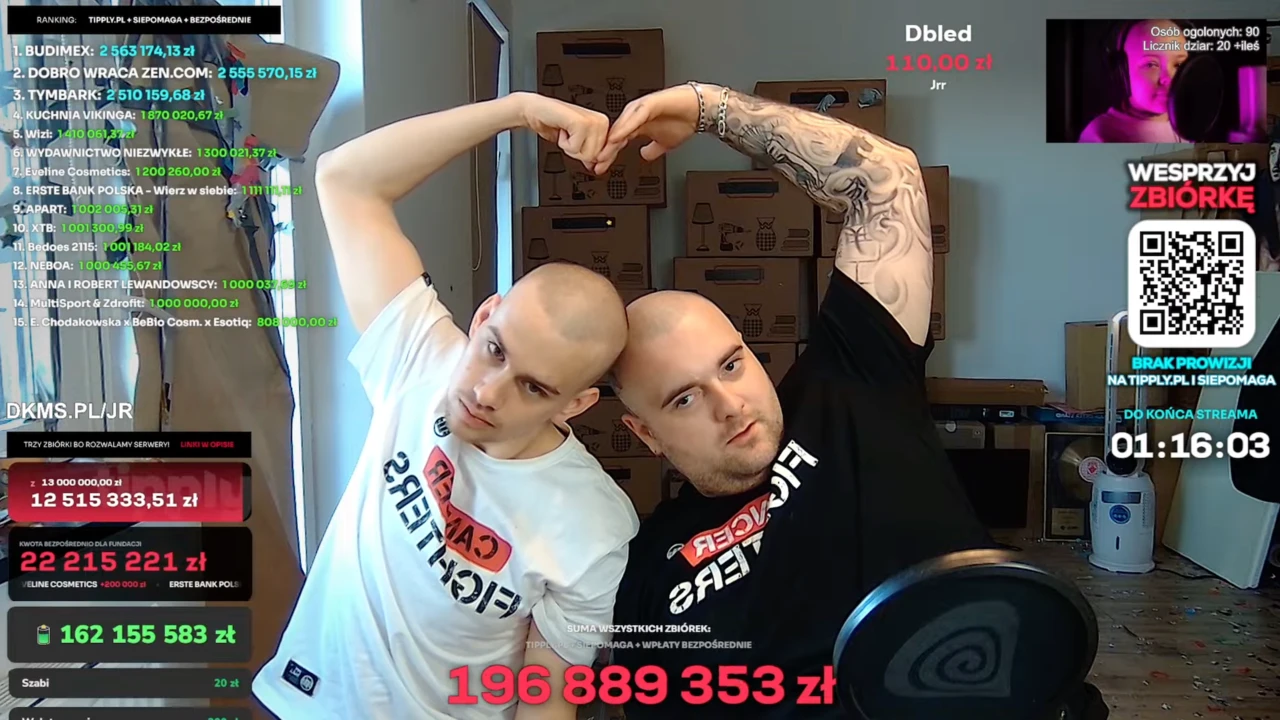
It all started with 11-year-old Maja Mecan, an oncology patient battling leukemia. Together with rapper Bedoes 2115, she recorded the track “Ciągle tutaj jestem” (which translates roughly to: “I’m Still Here”), which the internet quickly dubbed a “cancer diss track.” The musical project directly inspired popular Polish influencer Łatwogang. He pledged to listen to the song on a continuous livestream for one second for every like his TikTok video received. The explosive response from users forced him into a nine-day YouTube marathon.
A compilation featuring the best moments from the stream (in Polish):
The fundraiser’s results exceeded the organizers’ wildest expectations and, at a critical juncture, completely destabilized the infrastructure of Poland’s largest crowdfunding platforms. The donation mechanics relied on real-time microtransactions. At its peak, the YouTube broadcast drew over 1.5 million concurrent viewers. The traffic was so massive that major payment processors’ servers buckled under the load, forcing an emergency reroute to backup portals. A multitude of Polish companies, influencers, actors, and athletes joined the drive, donating millions of zloty and often jokingly competing for the top spot on the leaderboard, thereby encouraging even more people to chip in for the cause.
Ultimately, over 282 million zloty (the equivalent of more than $78 million) landed in the account of the oncology support foundation.
To understand the phenomenon of this social mobilization from an international perspective, one has to look at the historical context of philanthropy in Poland. For over three decades, the country has been known for massive, direct citizen engagement in charity. The most recognizable example is the Great Orchestra of Christmas Charity (WOŚP) – a massive annual drive where millions of Poles drop cash into traditional collection boxes held by volunteers on city streets. Those funds are then funneled directly into the healthcare system.
The efforts of Łatwogang and Bedoes represent an evolution of this tradition, adapted to the reality of a younger generation. Instead of physical collection boxes and nationwide televised concerts, the creators leveraged a home studio, streaming platforms, and the power of social media algorithms.
This model allowed them to reach a younger demographic that rarely consumes traditional media but is ready to instantly support initiatives championed by their internet idols. Following the official wrap-up of the campaign, the organizers promised full financial transparency. In a joint statement, the creators unequivocally distanced themselves from any profit motive:
“We are sitting down with the foundation to make sure that every single zloty is distributed as intended. We will not use this for ourselves in any way – ever”
These words quickly translated into action. The Cancer Fighters foundation launched a dedicated website exclusively for publicly tracking expenses and the progress of allocating the raised funds. The first tranches are already reaching patients in need – among other things, they have funded the treatment of several children at clinics in Poznań, covering the costs of innovative therapies running into hundreds of thousands of zlotys.