


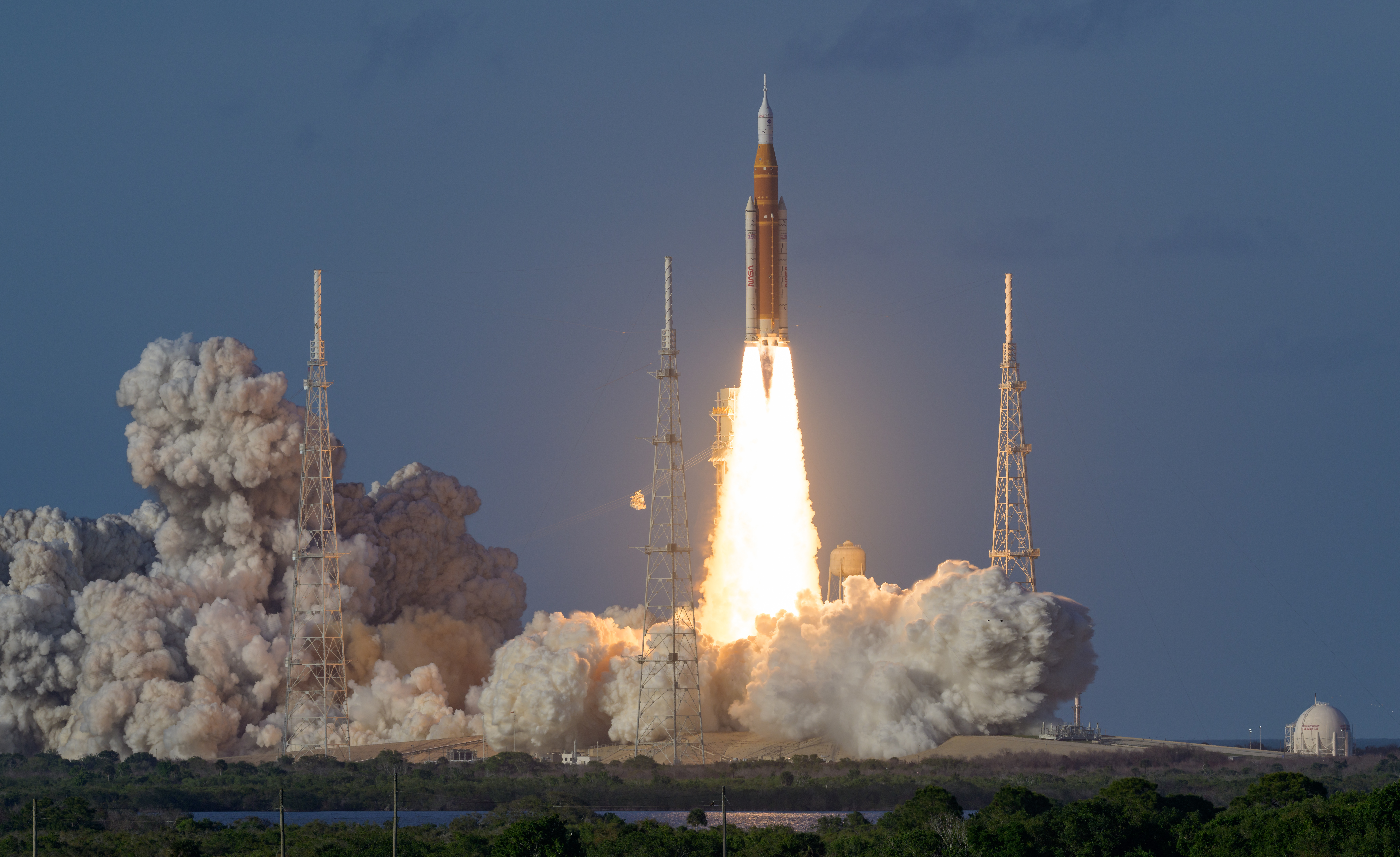
The farthest journey in history and the human side of the mission
The four astronauts – Commander Reid Wiseman, Pilot Victor Glover (the first Black astronaut on a deep space mission), Christina Koch (the first woman), and Canadian Jeremy Hansen – covered a total of nearly 1.1 million kilometers. Most notably, by traveling over 406,000 kilometers from our planet, the crew officially shattered the record for the maximum distance a human has traveled from Earth, originally set by the legendary Apollo 13 mission in 1970.
For the general public tuning into the live broadcast, the mission delivered sights and emotions unseen for decades. When Orion slipped behind the far side of the Moon, Earth lost all radio contact with the spacecraft for 40 minutes. It was during this blackout, flying just a few thousand miles above the lunar craters, that the crew witnessed a total solar eclipse from a vantage point no one had ever experienced before.
An engineering triumph with European roots
From a technical standpoint, the mission served as a rigorous stress test for the massive SLS rocket and the capsule itself, ultimately exceeding all expectations. The European Service Module (ESM), designed and built by the European Space Agency, emerged as a crucial unsung hero. This hardware was responsible for supplying the crew with power, water, and oxygen, as well as maintaining the proper temperature. The module’s main engine executed the trans-lunar injection maneuver with such absolute precision that NASA engineers confidently canceled two planned trajectory corrections.
The splashdown off the coast of San Diego, where the crew of the USS John P. Murtha was already waiting, was executed with similar surgical accuracy – the capsule landed less than a mile from the ideal, computer-targeted pinpoint.
Tough decisions, glitches, and compromises
As is typical for a mammoth technological undertaking valued in the tens of billions of dollars, the success of Artemis II did not come easily and required drastic on-the-fly adjustments. The thermal heat shield posed the greatest engineering challenge. During the uncrewed Artemis I flight, the capsule re-entered the atmosphere using a “skip-entry” method, which led to dangerous splintering of the protective coating. The risk was simply too high to repeat this maneuver with a human crew. The agency had to compromise, radically altering the flight profile to a steeper, direct descent. The decision proved to be a lifesaver, as the new trajectory allowed the shield to withstand the impact of plasma reaching temperatures of nearly 2,800 degrees Celsius.
Earth didn’t make things any easier, either. The flight launched under the shadow of a major ground infrastructure failure. A massive 70-meter antenna at the Goldstone facility in California – a critical node in the Deep Space Network – was damaged prior to liftoff. To avoid delaying the historic voyage, NASA was forced to patch communication gaps by leaning on external support. International agencies stepped up, with Japan’s JAXA and Australia’s CSIRO providing the necessary infrastructure to ensure precious contact with the crew was never lost during critical phases of the flight.
Destination: South Pole and Mars
The return of the Artemis II crew marks a pivotal moment for humanity. After years of delays, budget overruns, and skepticism, it is clear that the United States possesses a fully functional deep space exploration vehicle, proving that a return to the Moon is genuinely within reach.
The completion of this testing phase acts as a direct ticket for the Artemis III mission, currently slated for 2028. That is when humanity is set to physically step back onto the lunar surface, targeting a landing near the Moon’s South Pole.