


When The Matrix came out in the late 1990s, its most unsettling idea was not the special effects. It was the possibility that consciousness could be placed inside an artificial world — and experience it as real. Back then, it seemed like the kind of science fiction that worked precisely because it felt impossible.
But now it is 2026, and that idea no longer exists only in the movies. It now lives in laboratories, startups, venture capital portfolios, data centers, and scientific papers. Reality, however, has turned out to be both more interesting and more mundane. No one has “uploaded a soul into a computer.” And yet, in a limited sense, this is no longer pure science fiction. Scientists have mapped the neural connections in an adult fruit fly’s brain and built a computational model from that map. Then Eon Systems, a San Francisco startup, placed such a model inside a virtual body and used it to produce behavior that looked, at least from the outside, like the behavior of a living creature. So what does all this actually mean, and what does it suggest about the prospects of uploading the human mind?
Digitizing the Brain
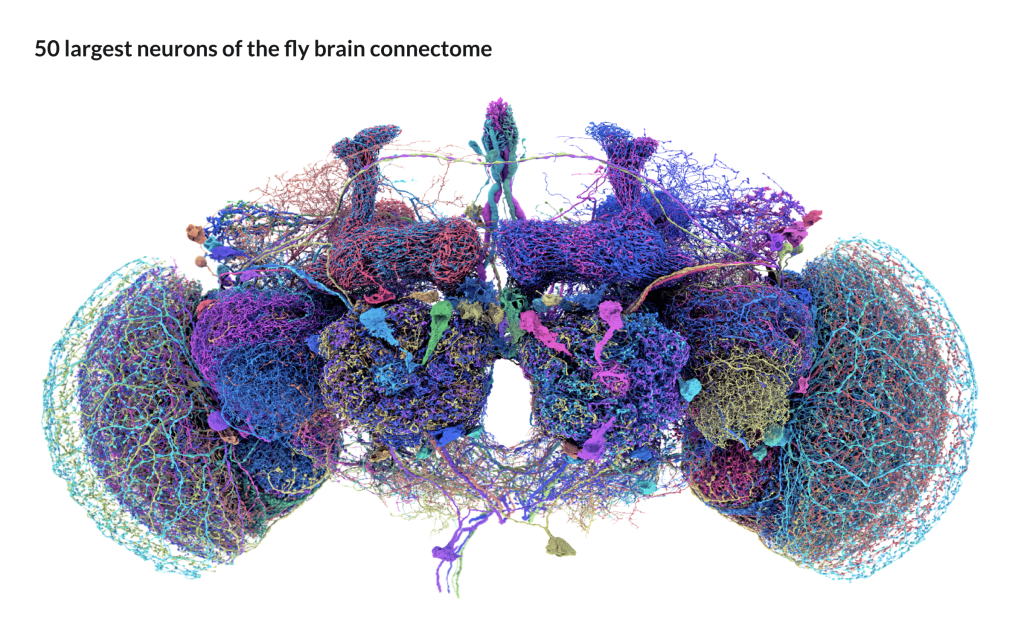
In October 2024, the international FlyWire consortium published in Nature, presenting the brain-wide connectivity of an adult female Drosophila melanogaster: 139,255 neurons and 54.5 million chemical synapses. For neuroscience, this was a landmark moment: the first nearly complete wiring diagram of a mature animal brain at this level of detail. Researchers now had, in effect, a full wiring diagram that could serve as the basis for simulating an insect’s behavior and responses in a virtual environment.
Also in the autumn of 2024, another paper was published on a computational model of the entire drosophila brain. Scientists built a digital model of the fly’s brain and tested whether it could reproduce aspects of the animal’s real behavior — for example, when eating or grooming itself. It turned out that it could: the model generated hypotheses that were then tested experimentally by observing the flies’ behavior and activating or silencing specific neurons with light.
In 2026, the story continued. The startup Eon Systems, which uses the slogan Upload the Human Mind, presented a “virtual embodied fly”: a digital body in a virtual environment controlled by a brain model built from already published scientific components. The creators themselves acknowledged that this was only a first step — an integration of existing parts and a system with a very limited range of sensory inputs and behaviors. But on social media and around the project, the language quickly became much more ambitious: “mind upload,” “brain emulation,” “proof of concept.”
Are the Claims Overstated?
A neurobiologist would probably describe the work as a combination of a connectome, simplified neural dynamics, and a body model. A founder might call it a minimally viable version of mind uploading. That gap matters. In March and April 2026, critics of the project explained quite bluntly why talk of an “uploaded animal” was premature: the public claims outpaced the transparent methodology behind them, while independent verification and reproducibility were still lacking. We also still do not have a universally accepted definition of consciousness itself, which makes claims about uploading it even harder to defend.
At the same time, it would be wrong to dismiss all of this as empty rhetoric. The experiment described above brings together several important lines of work at once: precise maps of neural connectivity, computational models of neural activity, and virtual bodies inside a physics simulator. In other words, we really are beginning to build something like digital organisms.
To avoid getting lost in grand promises, it helps to break the question into parts. First, can we map a brain? Yes — and the progress here has been enormous. Second, can we build models that reproduce some functions of the nervous system? Yes — and this is already being done. Third, can we prove that subjective experience has emerged inside such a model — what in everyday language we call consciousness? On that question, science still has no clear positive answer. And, importantly, there is not even agreement on what kind of test could meaningfully address it.
For researchers, whole brain emulation is a long technical program: gather data, reconstruct structure, model dynamics, and test the result experimentally. For some in Silicon Valley, it is also a worldview: if the mind is a process, then sooner or later it can be transferred to another substrate. This idea is not new. One of the best-known texts on the subject, Whole Brain Emulation: A Roadmap, was published back in 2008 under the editorship of Anders Sandberg and Nick Bostrom. But while at that time it was largely a futurist roadmap, today it rests on much firmer experimental ground.
Other Projects in This Area
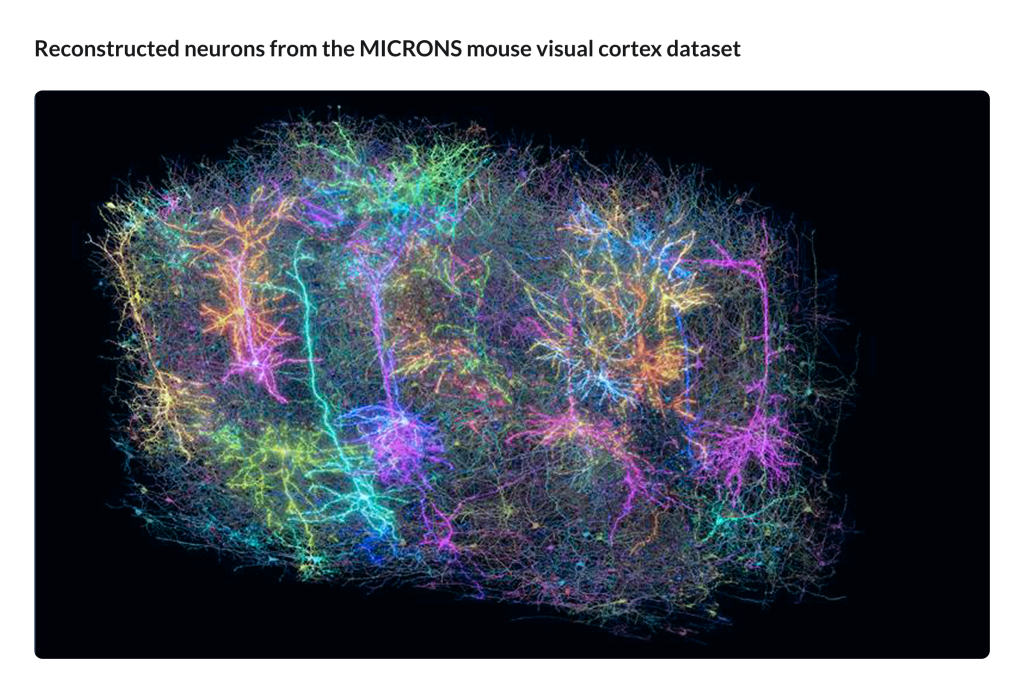
It is entirely possible that after the fly, the next major frontier will be the mouse. In 2025, researchers presented an ultra-detailed map and functional scheme of a tiny section of mouse visual cortex: around 84,000 neurons and roughly 524 million synapses in a sample no larger than a grain of sand. Scaling such work could eventually lead to the first emulation of a mammalian brain.
The OpenWorm project has spent years trying to build a digital C. elegans — a tiny worm with a nervous system of just 302 neurons. Blue Brain at EPFL develops biologically detailed digital reconstructions of the mouse brain and, back in 2015, published its famous reconstruction of a neocortical microcircuit. Piece by piece, this is how researchers are assembling data about how nervous systems work — data that may eventually make it possible to estimate the parameters required for future emulations.
Neuromorphic Chips
Some companies are trying to make hardware resemble the brain. That is where the idea of neuromorphic chips comes in. In 2014, IBM presented a system with 1 million programmable spiking neurons and 256 million configurable synapses. In 2024, Intel introduced Hala Point, currently the largest neuromorphic system, designed around roughly 1.15 billion “neurons.” But it is important not to give in to the marketing here: such machines are not actual synthetic minds, rather brain-inspired architectures. They are attempts to make computation more energy-efficient and event-driven.

What Should We Expect?
Ray Kurzweil, the futurist and Google researcher known for bold technological forecasts, argues that within ten years we may experience full immersion in virtual reality, enabled by billions of nanobots inside our bodies. Whether that timeline is realistic is hard to say.
But one thing does seem clear: we are standing at the threshold of something else, no less important — a transition from talking about the brain as a black box to a kind of engineering in which individual nervous systems can be mapped, modeled, and partially re-created in digital form. That is already changing science, and later it may change medicine as well. Such models could become platforms for studying disease, testing interventions, building neuroprosthetics, and developing brain-machine interfaces.
So the next time someone says that scientists have “almost uploaded consciousness,” it is worth pausing and asking: what exactly have they uploaded? A connectivity map? Simplified neural dynamics? Behavior in a virtual body? Or simply a very well-packaged dream? For now, the most honest answer is this: we are learning to create increasingly convincing digital creatures. But the question of whether that elusive thing we call consciousness actually emerges within them remains open. And perhaps it is one of the most interesting questions humanity has ever had to face.