



Andrej Karpathy has released an open-source project called “jobs”, designed to analyze how large language models might reshape the labor market. The tool uses AI itself to evaluate which tasks across different professions could potentially be automated by systems built on natural language processing.
The project relies on occupational data from the U.S. Bureau of Labor Statistics (BLS). In that dataset, each profession is described through a detailed list of tasks that make up day-to-day work. Instead of treating jobs as single, uniform roles, the tool analyzes those tasks one by one.
In simple terms, the system feeds a description of a specific task to a language model and asks whether it could realistically be performed by an AI system operating on text and digital data. If the task can be done without interacting with the physical world – such as analyzing information, writing text or communicating with users – it receives a higher automation score.
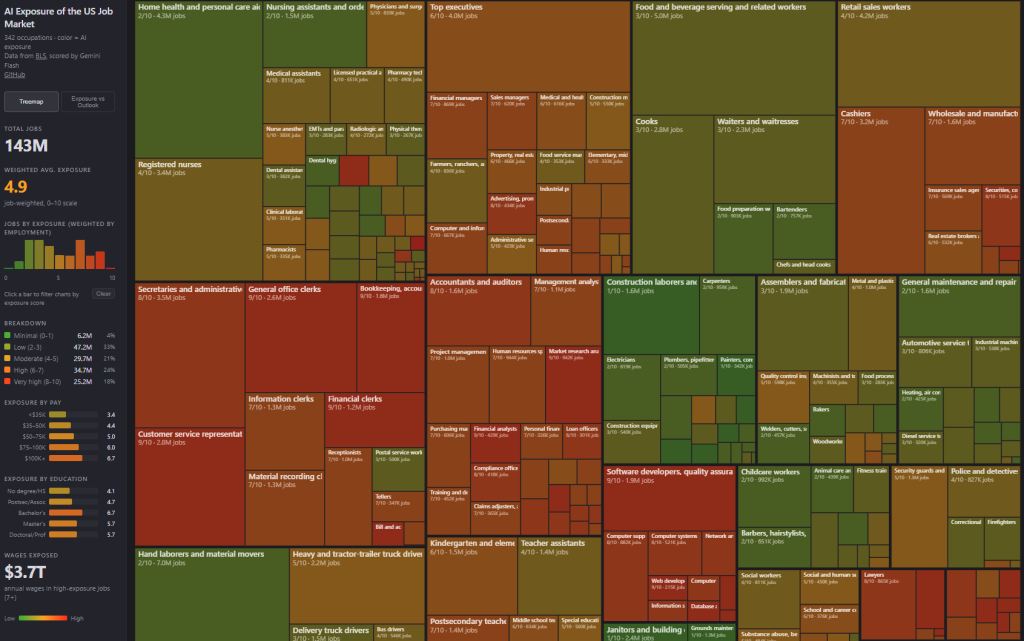
Once all the tasks associated with a profession are evaluated, the results are aggregated to estimate the overall level of exposure that job has to language-model automation. The tool doesn’t just produce a ranking of professions – it also highlights the specific tasks within each job that AI could potentially take over.
According to the data generated by the tool, some of the professions most exposed to automation by language models include translators, writers and authors, telemarketers, customer service representatives and technical support specialists. These roles rely heavily on text, communication and information processing.
Karpathy emphasizes that the project is experimental and has been released publicly along with its source code. The goal is not to predict the complete disappearance of particular professions, but rather to help analyze how generative AI might affect specific tasks within those jobs.
An interactive version of the tool allows users to explore hundreds of professions and see which parts of each job are most vulnerable to automation by language models. The results suggest that in many cases AI is less likely to eliminate entire professions and more likely to take over selected tasks currently performed by humans.