


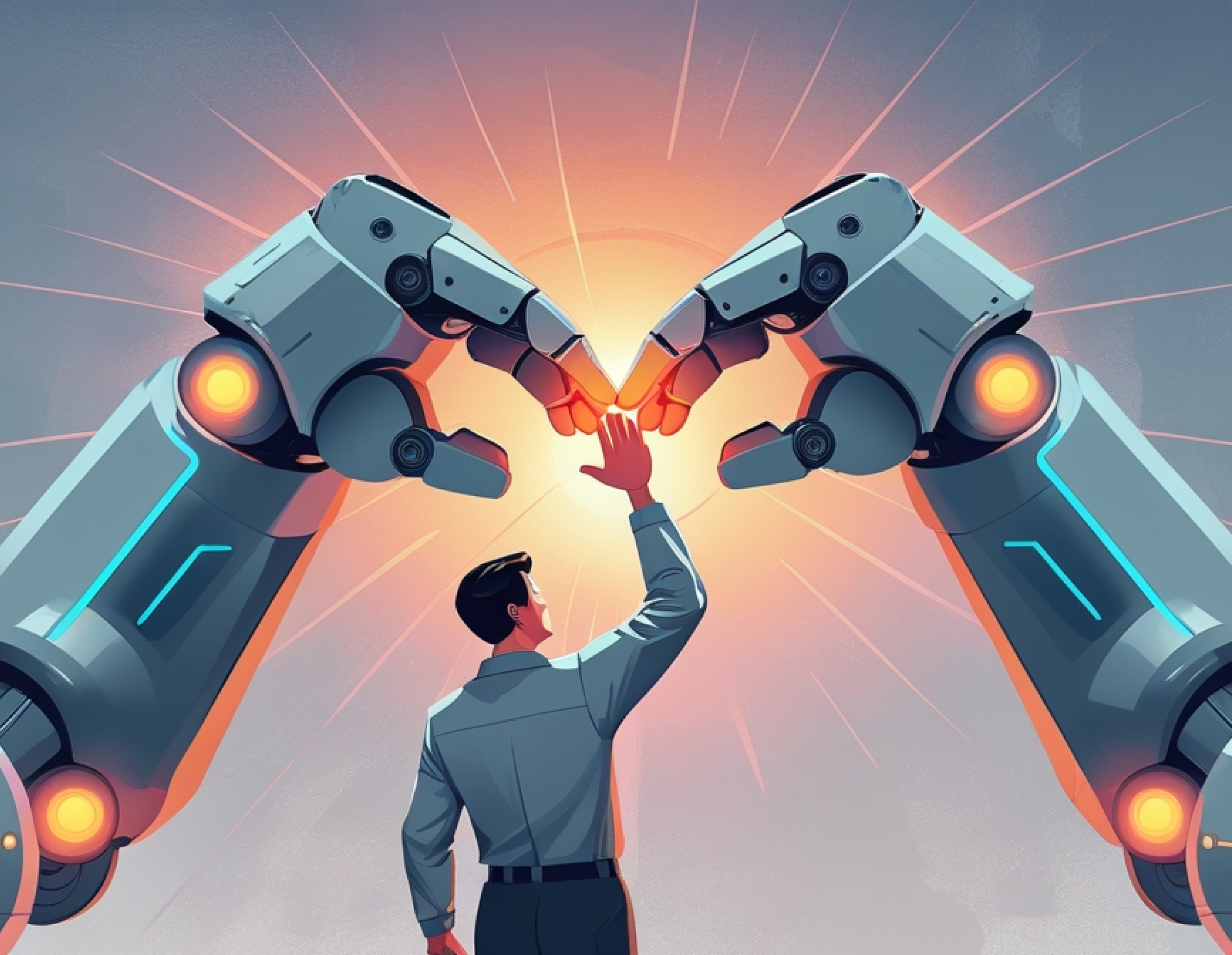
Talk of robots is everywhere — the assumption is that they’re destined to be AI made flesh, and the next leap in machine evolution. Yet few people understand where exactly these robots will appear, or how they will specifically help us. Sure, there are plenty of presentations showing humanoid-like robots dancing and pouring champagne into glasses. But that looks more like expensive toys. What should we expect in reality?
Most likely, robots will enter the everyday economy only when businesses begin mass-adopting far less cinematic designs: mobile platforms with manipulators, gripping, sorting, unloading, and transport systems driven by artificial intelligence. And this is already starting to happen. The International Federation of Robotics (IFR) reported in January that the global market for industrial robot installations reached a record $16.7 billion, and reported earlier that in 2024, 542,000 industrial robots were installed worldwide — more than twice as many as ten years ago.
Over the past few months, several landmark events have taken place in the industry. In February 2026, FedEx announced the launch of a fully autonomous robotic trailer unloader by Berkshire Grey — not a humanoid, but a highly specialized system for a heavy, monotonous, and costly logistics operation. And in January, Boston Dynamics unveiled a new version of Atlas as a product for industrial applications and announced plans for deployment in 2026 at Hyundai and Google DeepMind. In other words, the market is increasingly moving not toward an abstract “robot of the future,” but toward quite specific machines for specific tasks: from unloading trucks to working on assembly lines.
Mass adoption requires solving several hard problems. The main one is teaching AI to perceive the physical world not as a set of images, but as an environment with resistance, friction, fragility, random interference, poor lighting, non-standard object positions, and a high cost of error. Add to this the expensive collection of quality data, the poor transferability of skills between different robots, the difficulty of modeling reality in simulation, safety requirements, and the need for “graceful degradation” — when a system during a failure doesn’t damage an object, doesn’t freeze indefinitely, and doesn’t create a hazard for humans. We recently examined the theory behind this transition from digital to physical intelligence in a separate article.
Today we speak with Hleb Dapkiunas — Head of Robotics at Andersen Lab, a specialist working in physical AI, computer vision, and the practical implementation of robotics solutions. In this interview, we discuss not the abstract “future of robots,” but specific cases with commercial potential that could become commonplace tomorrow — sometimes in places that might surprise us.
2Digital: Where is the weakest link today in the autonomous robot–AI pairing?
Hleb: The weakest link has to do with the fact that, first and foremost, a robot must be able to detect the conditions it has suddenly found itself in as atypical — and on that basis, fail safely. It needs to stop, back away, request assistance, and then recover quickly enough to continue the task rather than getting stuck. That’s when there’s a real chance that robots will penetrate a large number of niches. Without this, the cost of failure is simply too high.
2Digital: If a robot encounters an atypical situation, how should the system know it’s time to stop rather than try to “figure out” the action on its own?
Hleb: In principle, even classical robots already have a fairly straightforward solution. We have several sources of information — physical or logical, for example: the robot has pushed against something (this is called force feedback), or we’ve programmed an action in software and detected a deviation from the intended route, path, or plan.
For every point at which we receive any kind of information, there is a so-called range, beyond which we decide the robot needs to enter safe mode. This kicks in at two stages: either when we’ve crossed the threshold, or when we haven’t crossed it but there is a stage of uncertainty — when we can’t tell whether we’re at the threshold or not.
In both cases, we always activate safe mode. And what happens at that moment? The robot either stops entirely, or significantly reduces the speed of its action so as not to harm anyone nearby. Or it takes some other action to return to its initial position.
2Digital: So the main challenge today is not simply teaching a robot to act, but teaching it to recognize the limits of its own competence?
Hleb: That is probably the Achilles’ heel of the industry right now. Things used to be simple — we’d tell the robot: “Go from point A to point B and do this.” There was no uncertainty, because no one assumed that an AI capable of making multifaceted decisions autonomously could exist. But now we assume that a robot can do anything, anywhere, at any time, react to any object.
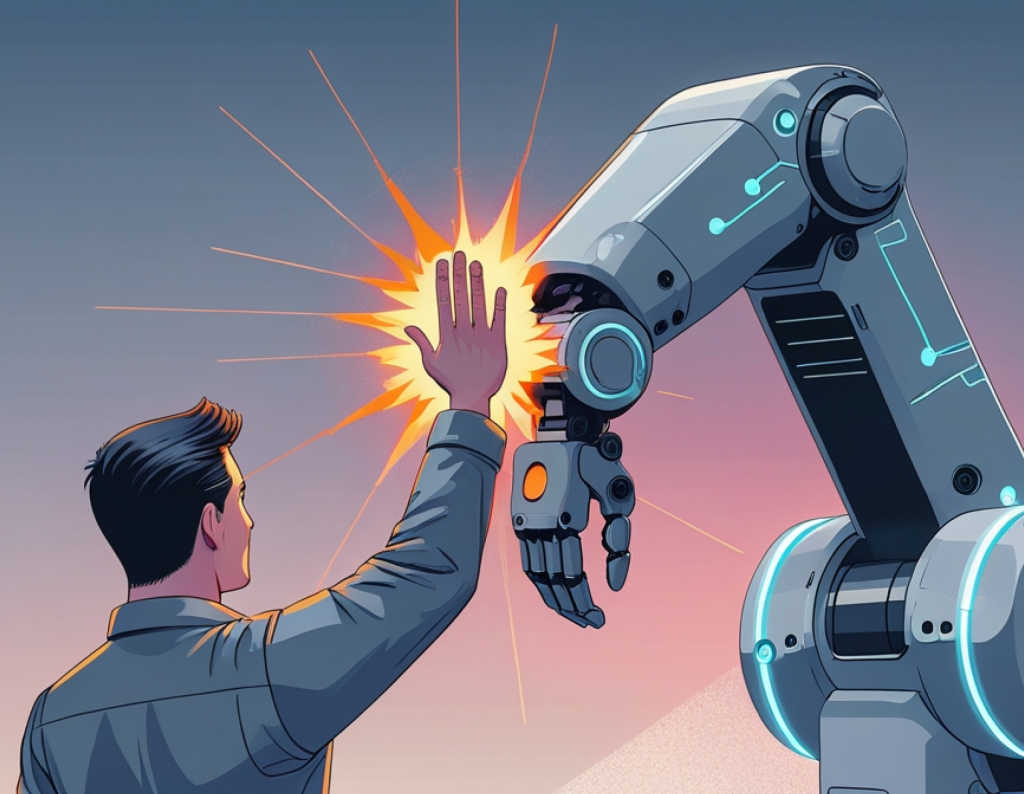
In an equation like that — where both point A and point B are unknown — the algorithms we currently have (machine learning, imitation learning, and so on) would need to think like humans. They can’t do that yet, so we’re forced to create a set of simple rules and constraints for the robot: if you go beyond these limits, stop.
The problem is that we can’t anticipate every variation in advance, and sometimes the definition of these limits becomes distorted in the real world. Let’s say we tell the robot: if you see a small, fast-moving object you might collide with — stop. First: we don’t know whether it will correctly identify that object. Let’s say it does. What’s the probability that it made an error? And what’s the probability that, while all this is happening, a third factor appears that we hadn’t accounted for — and the whole system breaks down?
There’s another problem: the robot stopped because it found itself in an unclear situation, and as a result, other processes stalled too. For instance, it halted in the middle of a tram line, or created a bottleneck on a factory assembly line.
So in these cases, the problems are currently so massive and critical that even the solutions we have are far from always suitable for mass adoption. It has already been statistically proven that robotaxis operating in the Palo Alto area are significantly safer than human drivers.
But there’s one problem: when complex edge cases arise — a police detainee on the street, or unusual road construction underway — the robot starts behaving erratically. And these cases break everything. Yet a human driver would never make such a mistake.
2Digital: The project you’re currently working on isn’t entirely public. But let’s try to discuss it within the bounds of what’s possible. It involves teaching artificial intelligence physics. How does that work?
Hleb: Let me remind you that today we have two ways of collecting training data for AI. The first is learning in the real world by trial and error. The second is collecting synthetic data in simulation.
The problem with synthetic data is that we can’t incorporate into the simulation the enormous number of variables that exist in real life.
When collecting data in reality, we also face limitations, because many variables — temperature, humidity, and so on — are simply not accounted for in many systems right now. Simply because they’re quite hard to collect. What’s primarily used today is classical imitation learning.
What matters here? There are two classic approaches in training: reinforcement learning and imitation learning. In many robot-related applications — automated vehicle control or a robot performing physical actions, for instance — reinforcement learning is not an option, because it has the system iterate through the maximum number of variants, including erroneous ones.
Erroneous actions simply cannot be permitted here. When training an AI to drive, we can’t let the car jerk the steering wheel however it pleases — the AI should only ever see cases where a human drives calmly. The same applies to a robot performing general-purpose tasks on an assembly line: it should only see cases where actions are performed calmly, deliberately, and safely. Because otherwise, one error in a million, and it makes a sharp movement that breaks everything.
So imitation learning is what remains. The problem is that all this data is currently collected manually, which is expensive. When it comes to taxis, for instance, you need to show millions of times how people drive a car. In our case, people directly operate the robot’s controller: picking up objects, setting them down, connecting them — and that’s how the data is gathered that helps the AI operating the robot work more precisely.
2Digital: How is this data captured?
Hleb: We have cameras — sometimes one, sometimes several — that capture an isometric image, meaning they allow for depth perception roughly the way human eyes do. There are several other parameters I can’t discuss right now, because that’s often where the know-how lies — the thing that gives these solutions their value.
The next step is to build up a large dataset. That’s the most valuable asset. These manipulations need to be performed tens and hundreds of thousands of times — specifically quality data. The more there is, the more confidently the AI will operate.
By the law of dialectics, quantity eventually becomes quality. And that’s exactly the stage we’re at right now.
2Digital: Can we talk about specific projects you’re working on? Give us a brief overview.
Hleb: I’ll try to be as careful as possible, because we have signed NDAs with many clients, and almost nobody wants to publicize how they’ve deployed it. Everyone understands perfectly well: the next day a competitor will read that article and start rolling out the same thing.
The first thing we offer clients is AI picking.
This is when a robot can, literally out of the box — regardless of whether it has ever seen this object before or not — understand what that object is, pick it up correctly, and move it from point A to point B. Importantly, our system differs from competitors in that it can handle complex edge cases: when an object is transparent, very small, or in a non-standard position, but still needs to be picked up. Not many companies have these capabilities. It’s a significant achievement.
2Digital: From a layperson’s perspective, this seems like the most primitive task imaginable.
Hleb: It does seem primitive when you have a limited number of objects and can load them into the system as CAD models, say. You tell the AI: “If you see this 3D model, always grip it at this point.” You can probably do that for ten objects, a hundred, maybe even a thousand.
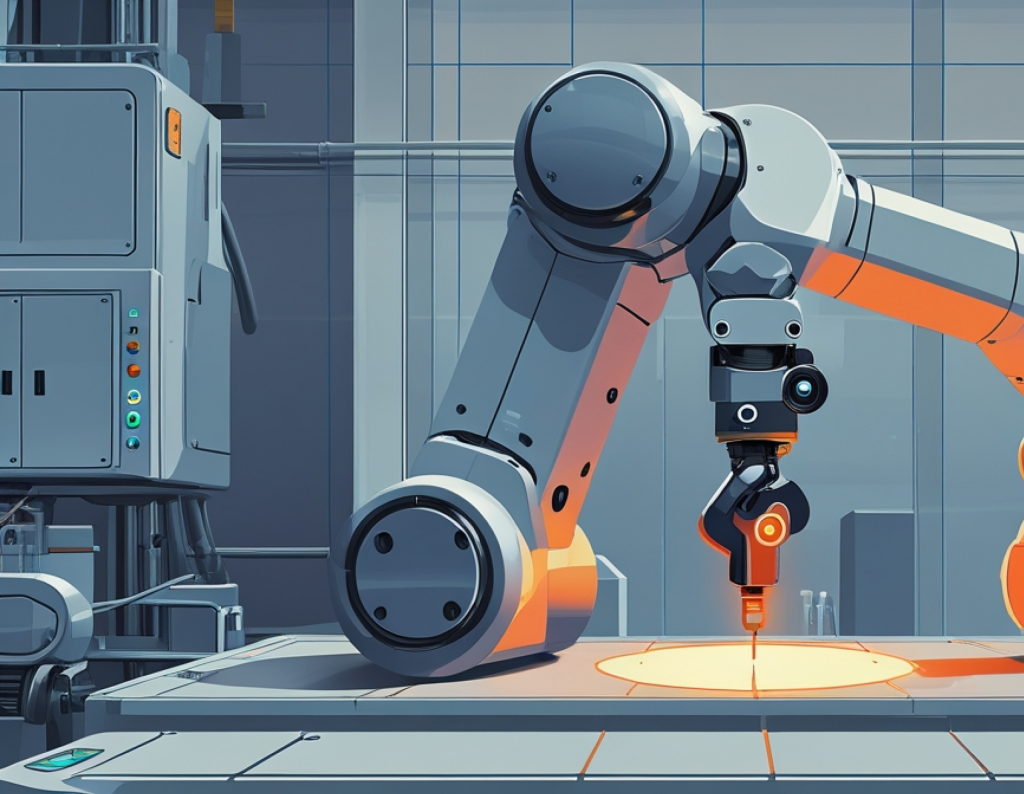
Now imagine you have a million, or millions of objects. They’re constantly changing — different colors, different materials: some plastic, some metal, some lying in a box. And the list is endless. You can’t prepare the system for everything in advance, and you have no margin for error — no breaking an object, tossing it aside, or placing it in the wrong spot.
2Digital: So the task is to run through an enormous number of scenarios and allow artificial intelligence to understand how to grasp any object — with what force, what the consequences of the grip will be, and what will happen when it sets it down.
Hleb: I’d just add one correction: saying millions of training scenarios already sounds optimistic to me. I think there need to be more. It’s an enormously labor-intensive undertaking.
There’s a term in coding — vibe coding. I’d say that imitation learning in robotics is a kind of vibe picking. The AI tries to recall whether it has seen something similar and, based on that, works out a strategy for interacting with the object. In reality, it doesn’t know what’s there. Bringing this as close as possible to a precise understanding, and then executing the action — that’s a genuinely difficult task.
2Digital: Alright, that’s the first development. What’s the second?
Hleb: The second direction relates to the fact that the market holds an enormous number of tasks requiring mobility. Previously, we had mobile AGV carts that moved along predefined trajectories from point A to point B. Now more advanced systems have emerged — AMRs, Autonomous Mobile Robots.
The idea is to mount a robotic arm on such a cart. This allows you to create those archetypal “humanoid” robots — only in Frankenstein form: a platform that drives, with an arm mounted on top.
But this Frankenstein is quite capable of replacing a warehouse worker or someone performing picking operations and more — and doing it on the move. The essence is that this autonomous mobile unit understands what’s around it, adapts to the environment, sees a person approaching, and stops. Unlike AGVs, it’s not dumb: it can coordinate its actions, operate in more complex scenarios where dozens or hundreds of such systems interact simultaneously.
So our task is to take existing developments in this area and turn them into flexible movement — so a robotic arm is no longer tied to a fixed spot, but can move around freely.
There’s also a third, more experimental direction. We’re still sizing it up, but I see real potential in it. It concerns human-in-the-loop — when a person connects directly to the robot.
2Digital: Why is that interesting?
Hleb: If we manage to pull it off, we’d be able to offer clients an unusual service: we replace a current employee at their production facility with a robot, and that robot is operated in real time, remotely, by a person living in another country.
This matters for two reasons. First — cost reduction. Second — enterprises have night shifts, staff shortages, not everyone shows up to work, and physical presence is often constrained by the local labor market.
In this model, people from other countries would de facto be able to work in places where labor costs are much higher, operating the robot in real time and handling precisely those edge cases that robots and AI systems currently struggle with: an object lying in a very complex position the system has never encountered, at which point the human takes over.
2Digital: What are the challenges with this model?
Hleb: The first problem is connectivity. It must always be stable and low-latency. That’s a major challenge.
Writing the software isn’t difficult. What’s technically hard is ensuring such a connection and being prepared for cases when the signal is weak or drops out. You need to be ready for bad scenarios, not just the ones where everything goes smoothly.
The second problem is cognitive load. Why, for instance, did the Meta metaverse story never take off? It turned out people don’t want to spend time in an artificial world — partly because VR headsets put a serious strain on the cognitive system and the body.
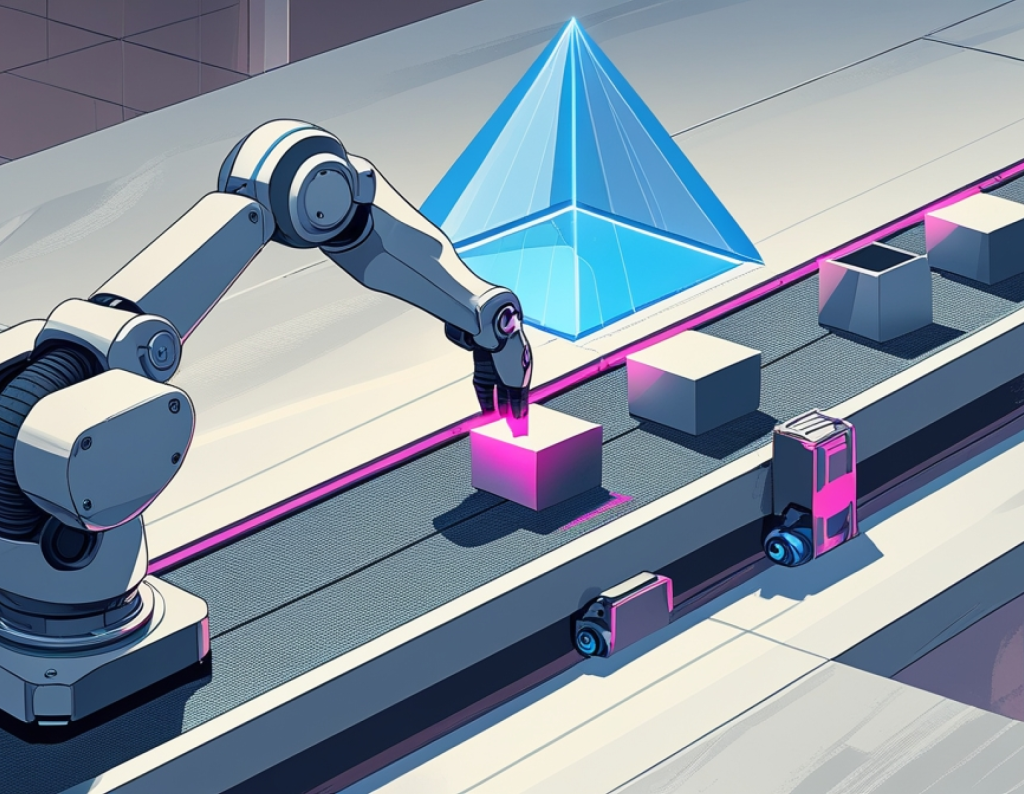
Most people find it uncomfortable to be in a virtual environment for more than an hour: the brain becomes overloaded. So the requirement on our end is to make this work either with genuinely comfortable VR headsets, or to abandon them altogether and invent a different interface.
The third problem is real-time deployment and fault tolerance.
You have to organize the workflow so that regardless of what happens to the person on the other side of the world — they suddenly step away, stop operating the robot, and so on — a quick operator handover takes place. The assembly line can’t stop; it must function without interruption.
This is a more experimental solution, but it has a solid foundation, and we’re currently at the very beginning of this market.
At the same time, it has one very important commercial advantage: the client doesn’t need to pay a large sum upfront to test a robot. You literally deploy it right away, connect it, and start seeing savings. No major initial investment required.
And that’s precisely the advantage of robotics transitioning from CapEx — capital expenditure — to OpEx, operating expenditure. This can significantly accelerate the growth of companies — humanoid and otherwise. They’ll tell their customers: don’t buy our robot for $50,000 or $100,000; rent it for €5,000 a month.
2Digital: In the video, we see you working with a manipulator. Is that footage real-time or sped up? There have been more than a few cases where startup demo videos had the time accelerated to make the robot’s movements look more confident.
Hleb: No, everything there is in real time. Yes, robots work slowly — but at baseline, we’re talking about roughly 600–1,000 picks per hour, which is the average market speed. That’s a relatively normal rate.
At exhibitions and demos, they run more slowly because of restrictions specific to the venue — to avoid injuring anyone. On a production floor, they typically work significantly faster.
And incidentally, that’s exactly why robots at exhibitions and presentations also move slowly. In reality, many of them can reach much higher speeds, but the cost of failure then becomes much higher too: a robot might accidentally harm someone, and one such incident is enough to shut down a multimillion-dollar project.
2Digital: What are your forecasts for the industry’s development in the coming years?
Hleb: I think there will be major optimization in logistics, intralogistics, and internal warehouse operations. A very large number of tasks there involve precisely picking — the simple transferring of objects from one place to another. And it’s exactly these tasks that robots can quite effectively optimize. Even when objects are new and have never been encountered before, systems can adapt.
I think another promising direction is service robots. I recently saw a robot on LinkedIn that folds towels in hotels, in the hospitality sector. Huge quantities of boxed towels come in every day — clean, but needing to be neatly folded. And there, robotic arms transfer them from place to place and automate the process entirely.
And there will be growth in simple customer-facing interactions that require no physical contact — a reception robot that talks to you, for instance. Those already exist, but there will be more of them, and they’ll keep improving. Language models can already handle voice responses quite competently. It’ll simply mean a robot embodiment standing in one place and talking to you.
As for humanoid-like robots capable of doing virtually anything — I don’t see a major breakthrough coming in the next three years. Beyond that horizon — quite possibly. But that’s already a conversation about ten years and more.